

Why Whitening Strips Stop Working After a Certain Point

The first few uses seemed to make a difference. Your teeth looked a little brighter, so you kept going. Then the progress appeared to stop.
That frustrating point is often called a whitening plateau. It does not necessarily mean whitening strips have suddenly stopped doing anything. It may simply mean they have already changed the type of staining they can reasonably affect. If you are now looking into teeth whitening services nearby, understanding why results have stalled can help you decide what to do next.
Are the Strips Really “Not Working”?
Not always.
Whitening changes are usually easiest to notice at the beginning because there is a visible contrast between your starting shade and the first improvement. Once that initial staining has lightened, later changes can become much harder to see.
You can get a different result depending on the lights, the photos, your expectations and even your new tooth shade.
So, before you begin to think it has stopped working, it's time to ask another question: Have your teeth reached the limit of what this whitening method can achieve?
1. You've Already Changed the Staining They Can Affect
The main benefit of whitening strips is effectiveness on discoloration that is susceptible to the whitening ingredients.
If you have stained teeth over time due to normal habits, the first few uses will noticeably improve the appearance of your teeth. Once much of that responsive staining has changed, however, repeating the same approach may produce smaller and smaller visible differences.
Think of it less like the whitening suddenly failing and more like reaching the limit of what that method can accomplish for your particular teeth.
Everyone starts from a different point. The extent and nature of staining vary from individual to individual and therefore, it is possible that two people using the same type of whitening product will not have the same degree of whitening.
2. Your Natural Tooth Shade Has Become More Noticeable
Not every tooth is naturally bright white.
Teeth have their own underlying color, and whitening does not mean turning every smile into the same shade. After external staining becomes less noticeable, your natural tooth color may simply become more obvious.
This is where expectations can become unrealistic.
You may compare your teeth with:
- Edited photographs
- Social media images
- Cosmetic dental work
- Someone with naturally lighter enamel
- Advertising images produced under bright studio lighting
None of these necessarily represents what is realistic for your own teeth.
A whitening plateau can therefore mean you are approaching your natural achievable shade rather than experiencing a treatment failure.
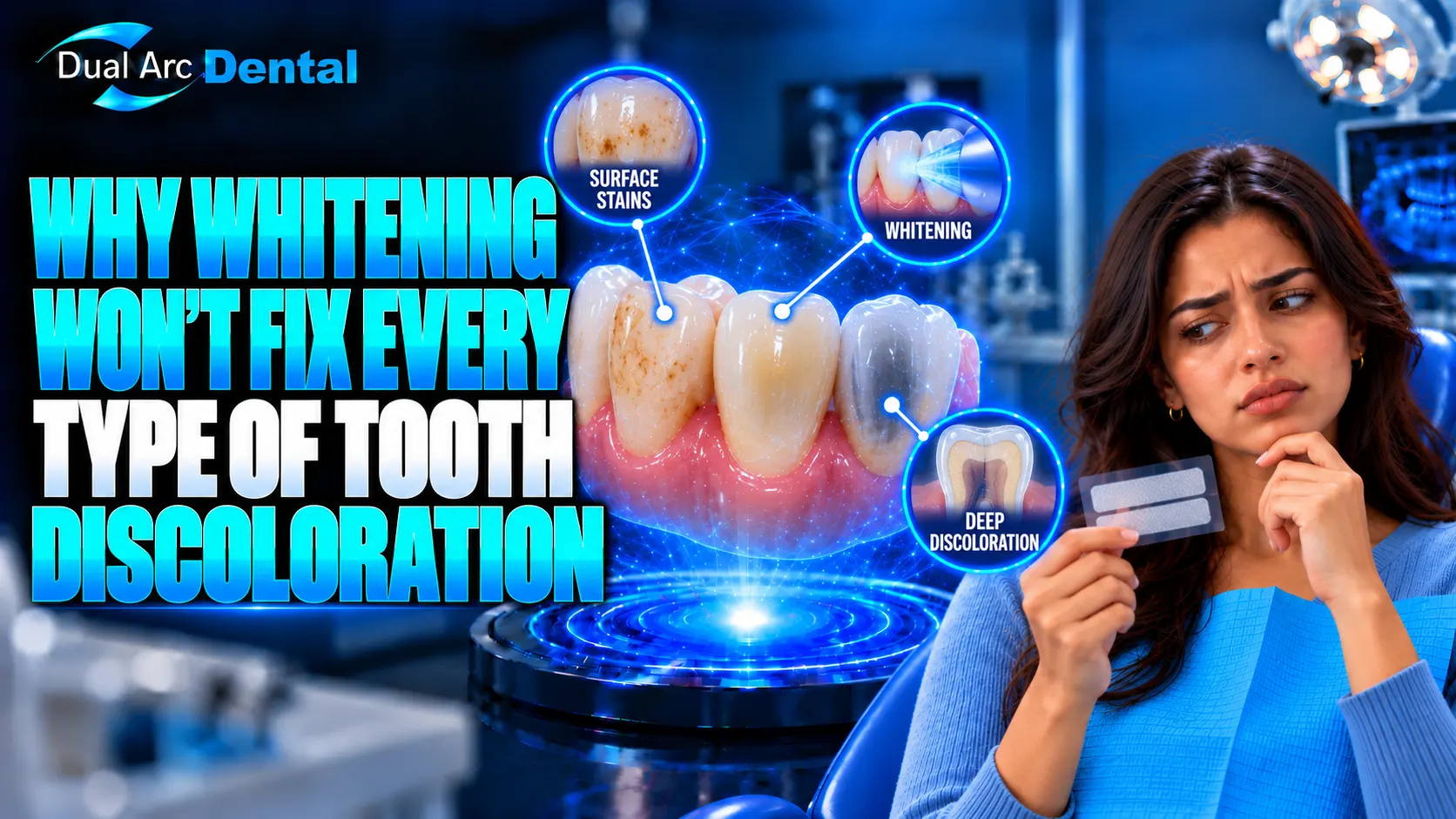
3. The Discoloration May Not Be Primarily on the Surface
Sometimes the color you are seeing is not mainly caused by surface staining.
Discoloration can develop for different reasons, including changes within the tooth itself. Factors such as previous trauma, aging and other dental factors can influence the appearance of a tooth.
If the discoloration is from a deeper layer of the tooth, you may not get the desired results with over-the-counter tooth whitening products.
It can also be the reason why one tooth stands out as being darker than the rest even after you've undergone general teeth whitening.
That doesn't necessarily mean something is wrong. After examining the tooth, a dentist can help to work out the problem and recommend the proper cosmetic treatment.
4. Dental Work Doesn't Behave Like Natural Enamel
Some dental restorations may cause dental whitening to look uneven.
Dental restorations such as fillings, crowns, veneers, and bridges do not react to whitening agents like natural teeth.
For instance, if an individual has surrounding natural teeth that have been bleached, the natural teeth may initially be a similar color but become much lighter than the restorations. After this, the restoration may suddenly look darker or more prominent, even though it isn't.
One of the reasons why whitening can get more complicated is if the person already has visible dental work.
A dentist can assess where restorations are located and explain whether they may be influencing the appearance of the final result.
Why Using More Product Isn't Automatically Better
When whitening stops producing obvious changes, using more product or whitening more frequently can seem like the obvious solution.
That is not necessarily a good idea.
Whitening products should be used according to their directions. Increasing the amount or frequency beyond those instructions does not guarantee a whiter result and may increase the likelihood of problems such as temporary tooth sensitivity or gum irritation.
More whitening also cannot change the basic reason your results have plateaued.
However, if it's a matter of your natural tooth color, a restoration you already have, or a form of discoloration that doesn't react well to strips, taking the same actions again and again might not help.
At that point it's more important to determine the cause than to keep attempting to whiten further.
Is It Time to Stop Guessing?
If whitening worked initially but has now stopped producing noticeable changes, a dental evaluation can provide useful context.
A dentist can look at:
- Your current tooth shade
- Whether staining appears external or internal
- Areas of uneven discoloration
- Existing fillings, crowns or veneers
- Gum and enamel condition
- Whether another dental issue could be affecting a tooth's color
This matters because "my teeth are not getting any whiter" can have several different explanations.
Professional evaluation does not automatically mean you need treatment. It simply gives you a clearer idea of what is realistic and whether additional whitening is appropriate.
When Teeth Whitening Services Nearby May Be Worth Exploring
Searching for teeth whitening services nearby can be a sensible option if you are not certain if at-home results are sufficient, if teeth are not whitening evenly, or if you're at a standstill with your at-home whitening process.
Professional assessment can be especially helpful if:
- One tooth remains darker than surrounding teeth
- You have visible crowns, veneers or fillings
- Your results look patchy or uneven
- Whitening repeatedly causes sensitivity
- Your teeth have stopped changing despite initial improvement
- You are unsure what type of discoloration you have
- You want realistic expectations before trying another approach
The goal is not simply to use a stronger whitening method. It is to determine what is actually affecting the appearance of your smile first.
Aim for an Appropriate Result, Not Endless Whitening
Whitening should have an endpoint.
You will be disappointed if your teeth are already at the point where you are not likely to get any lighter with the technique you are using and keep trying for a lighter tone.
At Dual Arc Dental, we are able to review your teeth and explore the changes you've noticed and determine if professional whitening or other cosmetic treatments might be right for your smile. If you have reached a plateau and want to try teeth whitening services nearby, you can have an evaluation in order to make your next decision based on your teeth, instead of relying on trial and error.
Frequently Asked Questions
1. Why did whitening strips work at first and then stop?
The initial improvement may come from changing staining that responds relatively easily to whitening. Once much of that staining has lightened, later improvements may become smaller or less noticeable.
2. Does a whitening plateau mean my teeth cannot get any whiter?
Not necessarily. It may mean you have reached the practical limit of that particular whitening method. Your natural tooth shade, type of discoloration and existing dental work can all influence the result.
3. Why are some of my teeth whiter than others after whitening?
Teeth can respond differently depending on their starting shade and the reason for their discoloration. Existing restorations can also create noticeable color differences because they may not whiten like natural teeth.
4. Will crowns or fillings become whiter with whitening strips?
Dental restorations generally do not respond to whitening in the same way as natural tooth structure. This can sometimes create a shade mismatch after surrounding teeth become lighter.
5. Should I keep whitening if my results have stopped changing?
Using whitening products for longer or more frequently than directed is not automatically beneficial. If results have plateaued, it is better to understand why before continuing.
6. Can stains return after whitening?
Yes. New staining can develop over time depending on diet, habits, oral hygiene and other factors. The rate at which color changes return varies from person to person.
7. When should I ask a dentist about uneven tooth color?
A dental assessment is worth considering if one tooth is significantly darker than the others, the color has changed unexpectedly, whitening produces uneven results or you are unsure what is causing the discoloration.