

Professional Teeth Whitening vs. Whitening Kits: Which Gives Better Results?
Whitening products are widely available, but they do not all work in the same way or produce the same level of control. Over-the-counter strips, gels and tray systems may improve mild surface discoloration, while professionally supervised treatment can offer a more controlled approach for suitable patients. For anyone comparing at-home products with professional teeth whitening services, the better option depends on the type of staining, oral health, sensitivity risk and the result being targeted.
The most important point is that tooth colour should be assessed before bleaching begins. Not every dark or discoloured tooth is simply stained, and whitening is not appropriate for every clinical situation.
Why Teeth Become Discoloured
Tooth discolouration can be broadly divided into external and internal changes.
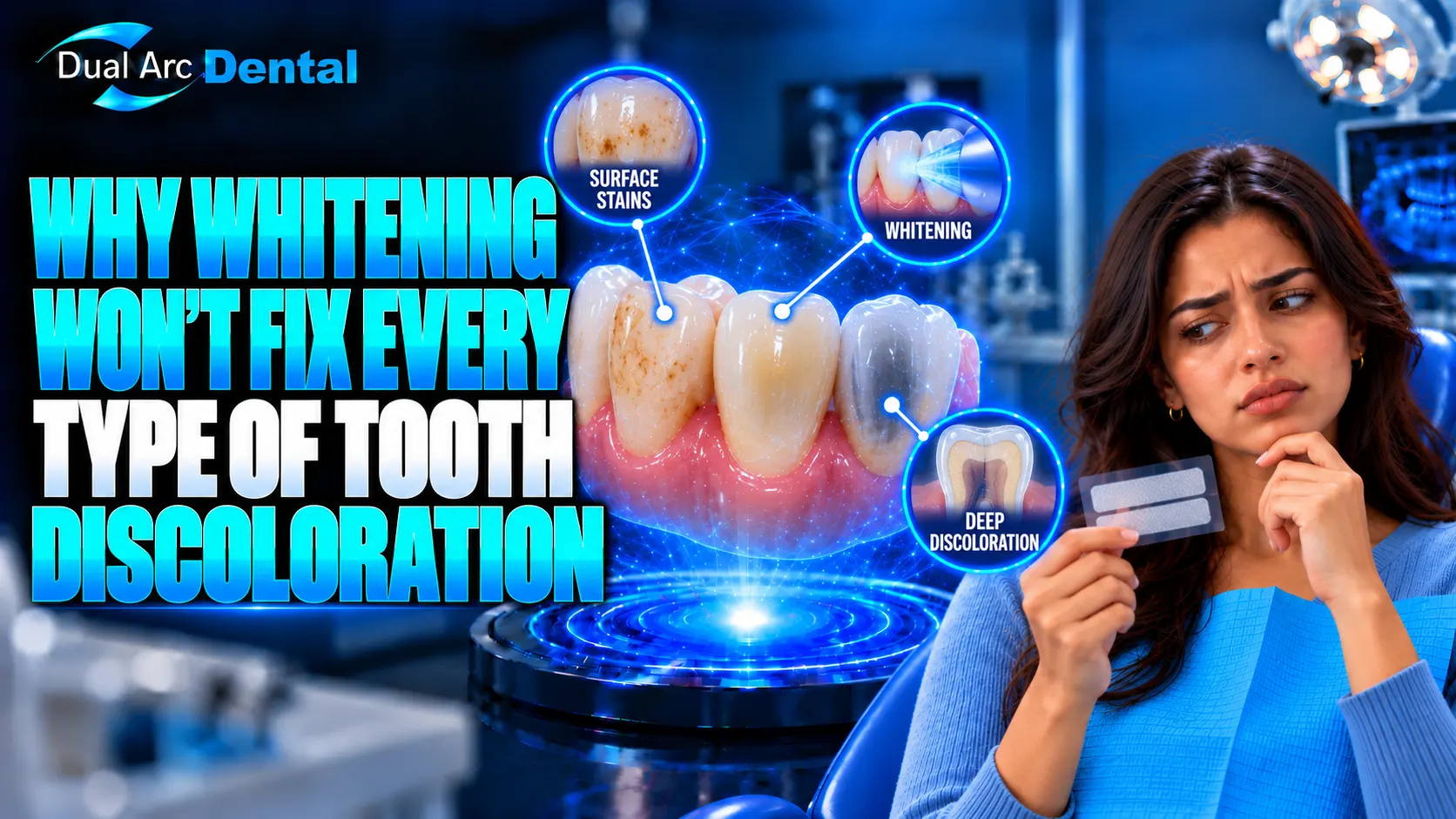
Extrinsic staining develops on the surface of the enamel and is commonly associated with tea, coffee, tobacco and strongly pigmented foods. Intrinsic discoloration originates within the tooth structure and may be related to ageing, trauma, developmental factors or previous dental treatment.
This distinction matters because whitening products do not respond equally well to every type of discolouration.
Professional assessment can also identify conditions that may resemble staining, including decay, defective restorations or changes affecting an individual tooth.
How Professional Whitening Differs From Retail Kits
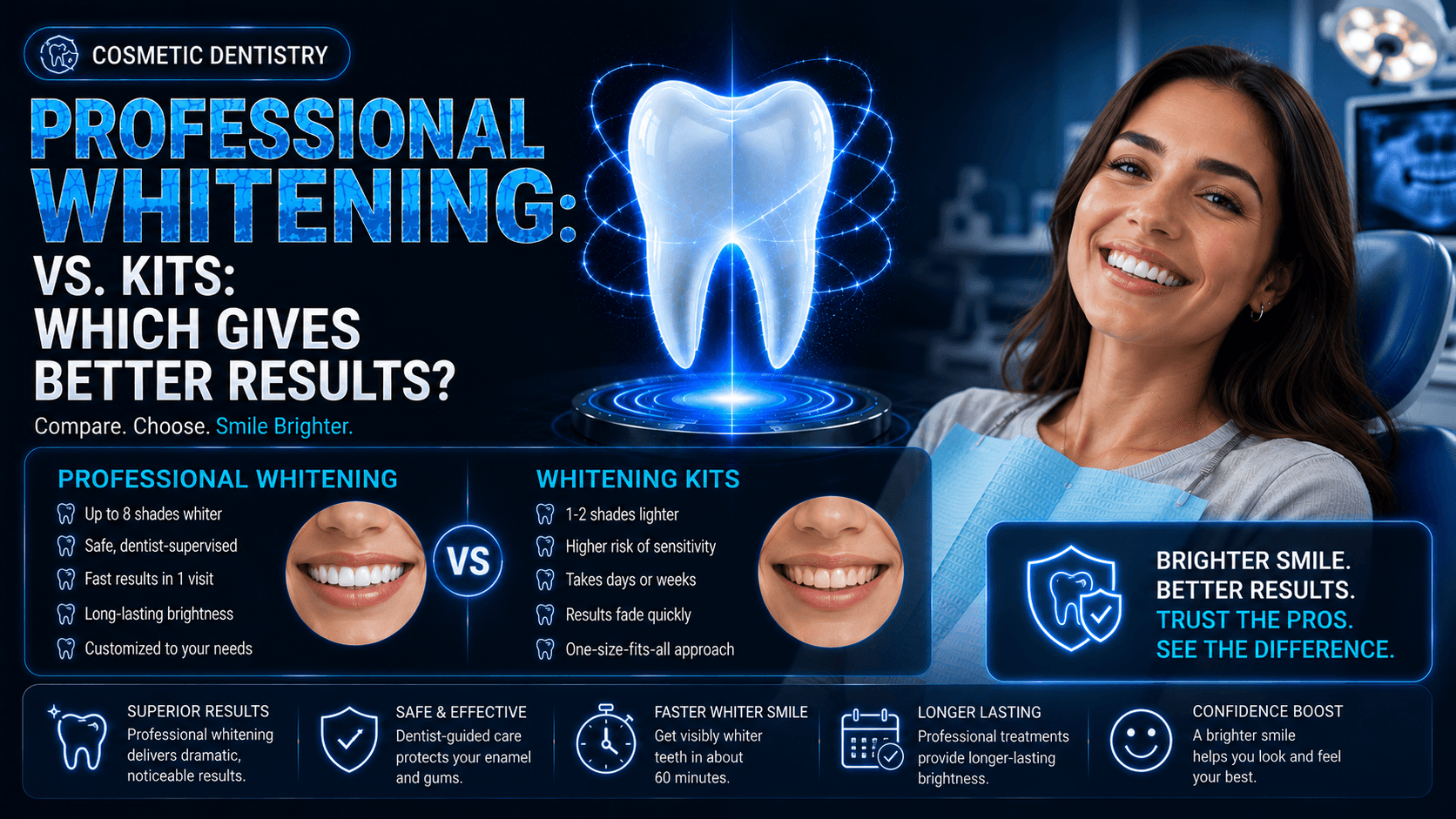
Both professional systems and many whitening kits rely on peroxide-based agents to break down coloured compounds within the tooth structure. The difference lies in how the treatment is selected, delivered and monitored.
Professional teeth whitening services typically involve an examination before treatment so that existing dental problems can be identified. The dentist can then determine whether whitening is appropriate and which approach may offer a predictable result.
By comparison, retail kits are designed for broad consumer use. They generally provide less individualisation and may use lower concentrations or standardised delivery systems.
The major differences often involve:
- Strength and formulation of the whitening agent
- Accuracy of gel placement
- Degree of professional supervision
- Ability to assess the cause of discolouration
- Management of sensitivity
- Control over gum contact and soft-tissue irritation
- Treatment planning around existing restorations
Which Option Usually Produces a More Noticeable Result?
Professional whitening generally provides greater control over both treatment strength and application.
This does not mean that every patient will achieve an extreme colour change. Tooth whitening has biological limits, and results vary according to the starting shade and underlying cause of discolouration.
Retail kits can work for mild staining, particularly when used correctly and consistently. However, results may be more gradual or less uniform if trays, strips or gels do not fit evenly across the teeth.
Patients seeking a more significant or predictable improvement may therefore prefer professional teeth whitening services, particularly when treatment needs to be adapted to individual tooth colour or sensitivity.
Sensitivity Is an Important Clinical Consideration
Temporary tooth sensitivity is one of the most common side effects of whitening.
Peroxide can move through enamel and dentine and temporarily stimulate the dental pulp. Some patients experience little or no discomfort, while others develop sensitivity to cold air, drinks or temperature changes.
Sensitivity risk can be influenced by:
- Existing enamel wear
- Exposed root surfaces
- Cracks or damaged teeth
- Gum recession
- Previous sensitivity
- Strength and duration of whitening treatment
Professional supervision allows these factors to be considered before treatment begins.
Using more whitening gel, leaving a product on for longer or applying it more frequently than instructed does not necessarily produce a better result. It can instead increase irritation and sensitivity.
What Whitening Cannot Change
This is one of the most important limitations to understand.
Whitening agents affect natural tooth structure. They do not reliably change the shade of crowns, veneers, bridges, fillings or other tooth-coloured restorations.
If restorations are visible when smiling, whitening natural teeth may create a shade difference between restored and unrestored areas.
A dentist can assess this before treatment and explain whether existing restorations may need to be considered as part of the overall cosmetic plan.
Whitening may also be less effective for certain deep intrinsic stains. In these situations, another cosmetic approach may sometimes be more appropriate.
Are Store-Bought Whitening Kits Unsafe?
Not necessarily.
Products used according to their instructions can be suitable for some individuals. The difficulty is that a consumer product cannot diagnose the condition of the teeth before whitening begins.
Applying whitening agents when untreated decay, gum inflammation, cracks or significant sensitivity are present may worsen discomfort or delay attention to an underlying dental problem.
A kit also cannot determine why one tooth has changed colour differently from the others. A single darkened tooth, particularly following trauma, should be assessed rather than repeatedly whitened without diagnosis.
Choosing Based on the Result, Not Convenience Alone
The decision between a whitening kit and professional treatment should not be based only on price or convenience.
For mild surface staining and modest expectations, an at-home product may provide an acceptable change. For patients who want greater clinical oversight, more controlled application and assessment of existing dental conditions, professional treatment offers clear advantages.
Professional teeth whitening services also allow expectations to be discussed before treatment, including how much improvement is realistically possible and whether existing restorations will affect the final appearance.
A More Controlled Approach to Whitening
Teeth whitening is a cosmetic procedure, but it still involves living dental tissues and should be approached accordingly. The strongest treatment is not automatically the best treatment. The goal is an appropriate colour improvement while protecting the teeth and gums.
Dual Arc Dental offers professional teeth whitening as part of its cosmetic dental services in Schertz. Patients considering whitening can have their teeth assessed first and discuss a treatment approach based on their oral health, existing restorations and cosmetic goals.
Frequently Asked Questions
1. Is professional whitening stronger than whitening kits?
Professional systems may use different concentrations and delivery methods, but the main advantage is clinical assessment and controlled application rather than strength alone.
2. How long do whitening results last?
Results vary according to diet, oral hygiene, tobacco use and individual tooth characteristics. Exposure to staining foods and drinks can gradually reduce the whitening effect.
3. Can whitening damage enamel?
When appropriately selected and used as directed, peroxide-based whitening is generally designed to alter tooth colour without removing enamel. Misuse or excessive application can increase sensitivity and soft-tissue irritation.
4. Will whitening change the colour of crowns or fillings?
No. Dental restorations such as crowns, veneers and tooth-coloured fillings do not respond to whitening in the same way as natural teeth.
5. Why should my teeth be checked before whitening?
An examination can identify decay, cracks, gum problems, exposed root surfaces or other conditions that may affect treatment safety, comfort or the final cosmetic result.