

Why Whitening Won't Fix Every Type of Tooth Discoloration
Two individuals may have the same color of teeth but experience varying outcomes from tooth whitening. That's because tooth color can shift in a variety of ways and not all of them will react to a bleaching treatment equally. One of the best things to understand before making a decision on teeth whitening services is whether the discoloration is primarily on the surface or originates from the inside of the tooth.
First Question: Where Is the Discoloration Coming From?
Where staining occurs and how it got there is important because whitening products typically are more effective on some staining than others.
Dentists commonly look at whether the change appears to involve:
- Stains that have collected on the tooth surface
- Changes within the tooth structure
- One tooth rather than several teeth
- Existing fillings, crowns, or other restorations
- Natural differences in tooth shade
What looks like a simple stain in the mirror may have a different underlying explanation. That is one reason assessing the teeth before whitening can be useful.
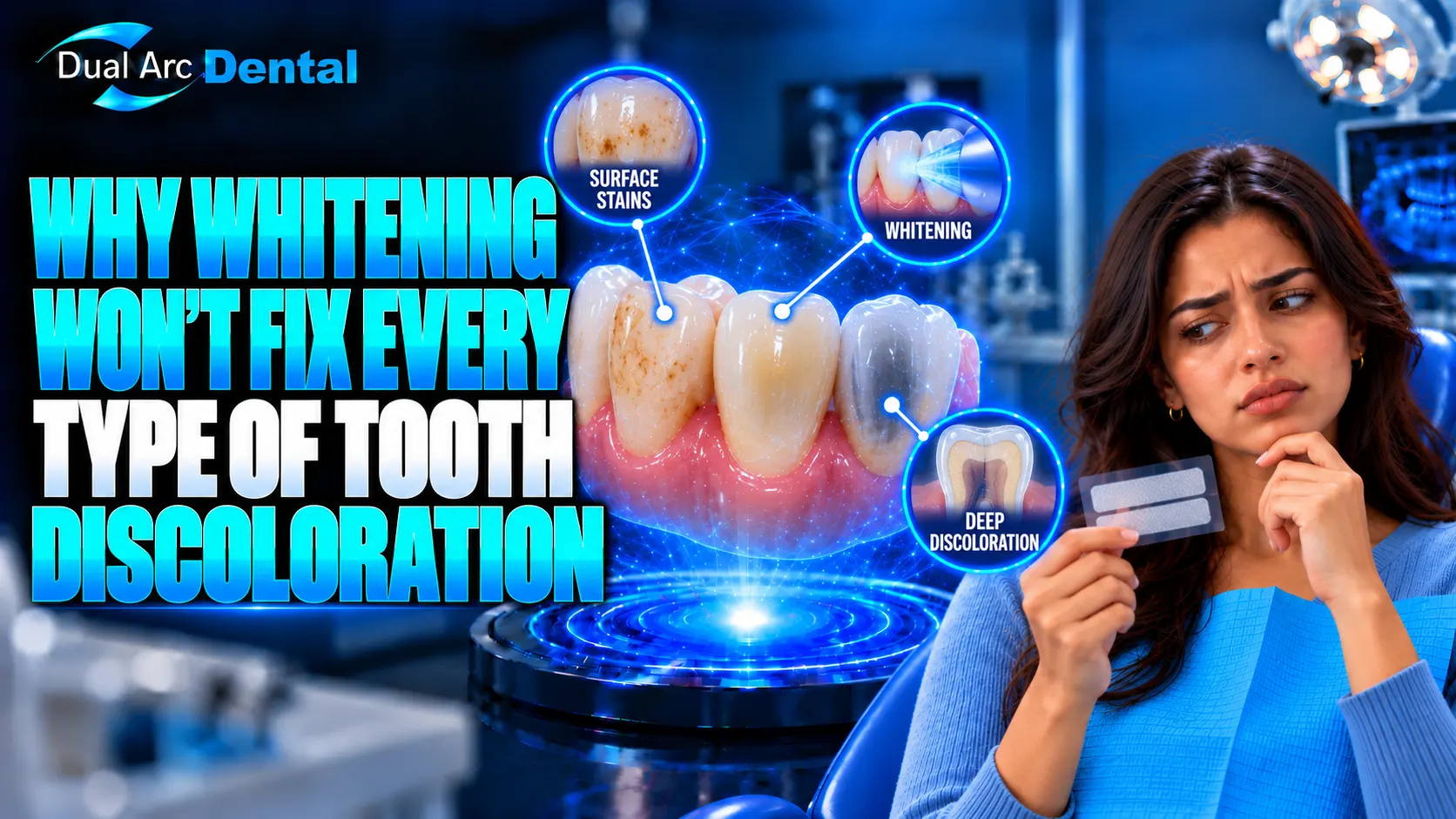
Discoloration on the Surface
Surface, or extrinsic, staining occurs on the outside of the teeth. Common activities can over time alter the appearance of the enamel.
Common contributors include:
- Coffee and tea
- Darkly colored foods and drinks
- Tobacco use
- Plaque and tartar buildup
- Changes in oral hygiene habits
These stains may make several teeth appear more yellow, brown, or dull over time. Some surface discoloration can be reduced through professional cleaning, while appropriate whitening may help with certain stains that remain.
However, not every dark or yellow area visible on a tooth is simply a surface stain.
Color Changes That Come From Within the Tooth
Sometimes the change in color originates within the tooth itself. This is known as intrinsic discoloration, and it can behave differently from ordinary surface staining.
Internal color changes can be related to such factors as tooth development, aging, past trauma, or inner tissue changes in a tooth. Some dental materials or even past treatments can also alter the appearance of a tooth.
Since the color isn't just on top of the enamel, if you whiten repeatedly, it may not give you what you'd hoped.
Sometimes you may not be able to tell the exact cause by just looking in the mirror. A dental examination can help to determine which possibility applies.
Why One Tooth Can Look Different From All the Others
Several teeth slowly becoming stained is a different story than one tooth suddenly becoming darker than its neighbors.
For instance, if a tooth was previously damaged years ago, it could turn a different color. Sometimes changes within the tooth can alter the appearance but not have any noticeable symptoms.
Not all dark-colored teeth indicate a serious dental issue, however. It does mean that immediately trying to whiten it may overlook the reason it looks different.
If one tooth has suddenly or gradually changed shade while the surrounding teeth have not, a dentist can examine it and determine whether further evaluation is appropriate.
What Tooth Color Can and Can't Tell You
Color provides a clue, but it cannot diagnose what is happening inside a tooth.
Yellow teeth do not automatically mean poor oral health. Likewise, a white tooth is not necessarily healthier than a naturally darker one. Natural tooth shades vary considerably between people.
A change in color can also have several possible explanations. The pattern, timing, dental history, condition of the enamel, and presence of restorations may all matter.
This is especially important when discoloration occurs alongside symptoms such as:
- Tooth pain or sensitivity
- Swelling around the tooth
- A crack or visible damage
- Changes following an injury
- A noticeably darker single tooth
Rather than using color alone to decide on treatment, a dental assessment can establish what is actually causing the change.
Why More Whitening Isn't Always the Answer
When whitening does not produce the expected shade, using more product or whitening more frequently is not necessarily the solution.
Whitening products are intended to be used according to their directions and for suitable teeth. Overuse can contribute to problems such as temporary tooth sensitivity or irritation of the gums.
Another practical concern is that not all materials in the mouth whiten the same. Tooth-colored fillings, crowns, veneers and other restorations generally do not change color like natural tooth structure. This can produce obvious contrast as a result of the shade differences if whitening is performed without taking into account other dental treatments.
If the first try is not effective, in terms of what was expected, it is better to know why, rather than try the same thing again.
How Professional Teeth Whitening Services Fit Into the Picture
Whitening isn't just about picking the degree of whitening you want for your smile; there's much more to professional whitening. Teeth need to be evaluated. The nature of the discoloration, past restorations, and the person's expectations are all factors that should be taken into account.
A dentist can review the mouth and talk about whether teeth whitening is likely to help with the specific type of discoloration before recommending teeth whitening services.
This also allows you to spot any problems which may need to be addressed first. For instance, it's possible that a strange shift with regard to one tooth should be examined before it's worth considering cosmetic whitening.
It's not just about achieving the whitest teeth. The goal is to determine whether whitening is appropriate and what outcome can reasonably be expected.
What If Whitening Isn't Suitable for the Type of Discoloration?
When discoloration is likely to be resistant to whitening, that isn't necessarily a reason not to do anything.
The next step depends on the reason for the difference in the appearance of the tooth or teeth. Depending on the condition of the teeth, the location of the discoloration, any existing dental work, and the patient's desired outcome, a dentist may explore cosmetic and restorative options.
No one alternative is correct for all varieties of discoloration. Removing surface stains might be all that is needed for one surface-stained tooth, and yet it would be a solution that makes no sense for someone with widespread intrinsic discoloration.
That is why identifying the cause should be the first action taken, before a cosmetic approach is considered.
Start With the Reason for the Color Change
We at Dual Arc Dental think that the initial question shouldn't be "How white can my teeth get?” The question should be "Why do my teeth look like this?”
When it comes to teeth whitening services in Schertz, TX, our staff can assess your teeth to see what kind of discoloration you have and determine if teeth whitening is a good option for your smile. If whitening is not right for you, we can discuss other options that may be suitable based on your individual needs.
Frequently Asked Questions
1. Are yellow teeth easier to whiten than very dark teeth?
Not necessarily. The response depends on the cause of the discoloration rather than color alone. Some yellowish staining may respond to whitening, while discoloration originating within the tooth can be less predictable. A dentist can assess the type of color change before treatment.
2. Should I be concerned if only one tooth is darker?
A single darker tooth can have several possible causes, including previous trauma or changes within the tooth. It does not automatically indicate a serious problem, but a noticeably different tooth should be evaluated rather than repeatedly whitened without knowing the cause.
3. Will professional whitening make every tooth the same shade?
Not always. Natural teeth can respond differently, and crowns, veneers, fillings, and other restorations generally do not change color in the same way as natural tooth structure. Your dentist can discuss realistic expectations beforehand.
4. Why should my teeth be examined before whitening?
An examination helps determine the likely source of discoloration and checks for dental conditions or existing restorations that could affect the whitening plan. It can also identify situations where the color change should be investigated before cosmetic treatment.
5. Can stains return after teeth have been whitened?
Yes. Whitening does not permanently prevent new discoloration. Foods, beverages, tobacco, aging, and other factors can gradually affect tooth color again. Oral hygiene habits and individual lifestyle factors can influence how long whitening results remain noticeable.