

Tooth Infection Without Swelling: Can It Still Be an Emergency?
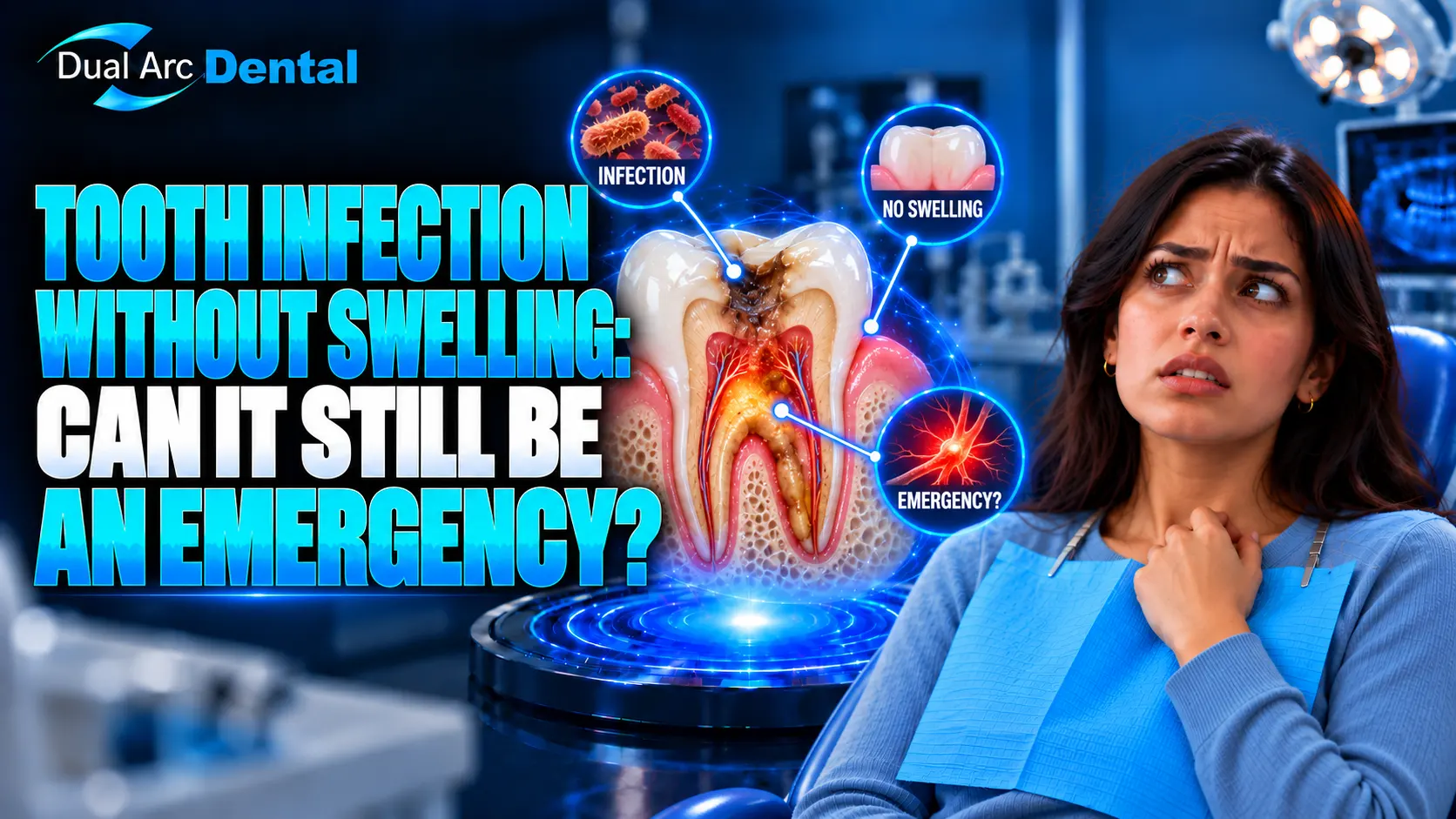
The absence of swelling does not necessarily indicate no serious dental problem. Facial and gum swelling may not be present with dental infections, especially in early stages. If any pain, sensitivity, unusual taste or other unexplained change occurs, seeking emergency dental care nearby may be appropriate rather than waiting for swelling to appear.
Why Do People Associate Dental Infection With a Swollen Face?
A dental infection can have more apparent symptoms, including facial swelling. It is seen and hard to miss and is commonly regarded as an obvious indicator that something is amiss.
This can lead to an incorrect assumption, if your face or head looks normal, then there must not be anything wrong.
In truth, dental issues don't always occur in exactly the same fashion. The infection can start in or around a tooth without any visible swelling. The symptoms may also vary based on the tooth affected, the way it has been affected and the reaction of the tissues around it.
Swelling matters, but it is only one piece of the picture.
Can Infection Be Present Before You Notice Swelling?
Yes. At times, an infection in the teeth may not have visually apparent swelling.
For instance, after severe decay, a crack, past trauma or other dental issues, bacteria can reach the inside of the tooth. At first the changes may only be in the tooth or in very small areas of surrounding tissue and the first symptom might be discomfort, not a swollen cheek or gum.
Some people report continued sensitivity. Other people feel pain when they bite, a tooth may throb, tenderness around the tooth or an unusual taste. There are also times when symptoms are not severe or do not occur frequently.
That is why you cannot always determine what is going on under the surface from what you see. A dental exam is required to help determine the cause.
What Other Changes Should Get Your Attention?
Rather than just asking, "Is my face swollen?" check if there has been a change in your mouth.
If you see trends like the following, make sure to schedule a dental exam:
- A tooth that has recently started hurting
- Pain when biting or chewing
- Sensitivity that lasts longer than expected
- A bad or unusual taste that keeps returning
- Tenderness or changes in the gum around one tooth
- A tooth becoming noticeably darker
- Discomfort that disappears and then returns
- Symptoms becoming more frequent or intense
- A small raised area or pimple-like change on the gum
The presence of these signs does not necessarily indicate that an infection exists. Symptoms can be similar for cavities, cracked teeth, gum issues, bite-related problems, and other conditions.
The key is to know that if it's a change, and it's new or worse, it's worth paying attention to.
Think in Terms of Change, Not Just Swelling
A useful way to judge a dental problem is to compare what you are experiencing now with what is normal for you.
New pain
A tooth that suddenly begins hurting is worth paying attention to, even if your gums and face look normal.
Pain changing character
Occasional sensitivity that turns into persistent, throbbing or more discomfort is a change. That change cannot be taken for granted, but must be determined.
Sensitivity
There are a number of reasons for sensitivity to heat or cold. If it is new, severe or persists after the temperature stimulus is removed, a dentist can examine the tooth.
Unusual taste
If a foul taste or sensation of liquid around a tooth or gum persists, it shouldn't be ignored, especially if it is causing discomfort or pain.
Gum changes
Check for localized areas of redness, tenderness, a raised area or other changes around a particular tooth.
Tooth color changes
A tooth that becomes darker after trauma or for no obvious reason may require assessment. Color change alone does not establish the cause.
General worsening
Probably the most helpful signal is progression. For some things, it may not be enough to wait and see if it swells to make a decision about urgency.
When Does a Dental Problem Become an Emergency?
Not every toothache requires the same level of response. Think of dental problems along an urgency spectrum.
Monitor and arrange an assessment
Mild symptoms that are not worsening may still warrant a routine dental appointment, especially if they persist or repeatedly return.
This could include mild sensitivity, occasional discomfort, or a subtle change around a tooth.
Seek prompt dental attention
In general, if you are experiencing persistent toothache, worsening pain, severe pain when biting, recurring gum changes, or pain that is interfering with eating or sleeping, it's time to have a check-up.
Searching for emergency dental care nearby can also be prudent if you are not sure whether your symptoms can wait for your next appointment. A dental team can help to understand what to do next.
Seek urgent or emergency evaluation
Certain symptoms require greater urgency. Seek prompt professional help if dental symptoms are accompanied by significant or rapidly increasing facial or neck swelling, fever or feeling seriously unwell.
Difficulty breathing or swallowing is particularly concerning and warrants immediate medical attention rather than waiting for a routine dental visit.
Why Waiting for Visible Swelling Can Be Misleading
The arbitrary threshold of waiting for swelling does not necessarily correspond to dental problems.
A tooth may cause pain without causing swelling of the face. Conversely, symptoms can sometimes temporarily lessen even though the underlying dental problem has not been resolved.
Pain disappearing is therefore not always proof that everything is fine.
The better question is not:
"Has my face swollen yet?"
It is:
"Has it changed with this tooth and does this change require evaluation?"
When a dentist makes an early diagnosis, he or she has a chance to determine what's causing the symptoms and discuss treatment before assuming how the issue will develop.
Where Does Emergency Dental Care Nearby Fit In?
Emergency dentistry can prove helpful when a dental condition arises quickly, is hard to deal with or if there is some uncertainty as to whether or not it is suitable to wait.
If you are searching for emergency dental care nearby, describe your situation instead of just asking if there is any swelling involved. Mention when the symptoms began, whether they are worsening, what triggers the discomfort, and whether you have noticed changes in the tooth or surrounding gum.
A dentist may examine the tooth and surrounding tissues and, where appropriate, use dental imaging or other diagnostic methods to investigate the source of the problem.
Depending on the results of that evaluation, the treatment needed can vary. That's why relying on a single symptom or the lack of one can be a mistake when one is trying to self-diagnose an infection.
When Your Mouth Is Telling You Something Has Changed
We prefer to educate you about a new dental condition rather than wait until you have a dramatic symptom before you seek help at Dual Arc Dental.
If a tooth has started hurting, sensitivity has changed, or something simply does not feel normal, our team can examine the area and determine what may be causing it. For urgent dental concerns in Schertz, TX, contact us to discuss your symptoms and the appropriate level of care.
Frequently Asked Questions
1. Can you have a tooth infection without swelling?
Yes. A dental infection may sometimes be present without visible gum or facial swelling. Pain, tenderness, sensitivity, an unusual taste, or other changes may occur instead. A dentist needs to evaluate the tooth to determine the cause.
2. Can a tooth infection exist without pain?
It is possible for some dental infections or problems affecting the inside of a tooth to cause little or no pain. Symptoms alone cannot reliably rule an infection in or out, which is why suspicious changes should be professionally assessed.
3. Is a tooth infection without swelling an emergency?
Not automatically. Urgency depends on the overall symptom pattern rather than swelling alone. Persistent or worsening pain deserves prompt dental attention, while difficulty breathing or swallowing, rapidly increasing swelling, or serious systemic illness requires urgent medical evaluation.
4. How does a dentist check for a possible tooth infection?
The dentist may ask about your symptoms and dental history, examine the tooth and surrounding gums, perform appropriate clinical tests, and use dental imaging when necessary. The findings help determine whether infection or another dental condition is responsible.
5. Should I wait until my face swells before seeing a dentist?
No. Visible swelling should not be used as the point at which you finally seek care. New, persistent, or worsening dental symptoms can justify an assessment before swelling develops.
6. What warning signs need immediate attention?
Difficulty breathing or swallowing requires immediate medical attention. Rapidly increasing facial or neck swelling, fever accompanied by significant dental symptoms, or feeling seriously unwell also warrants urgent professional evaluation.