
9 Signs Your Toothache Is Actually A Dental Emergency
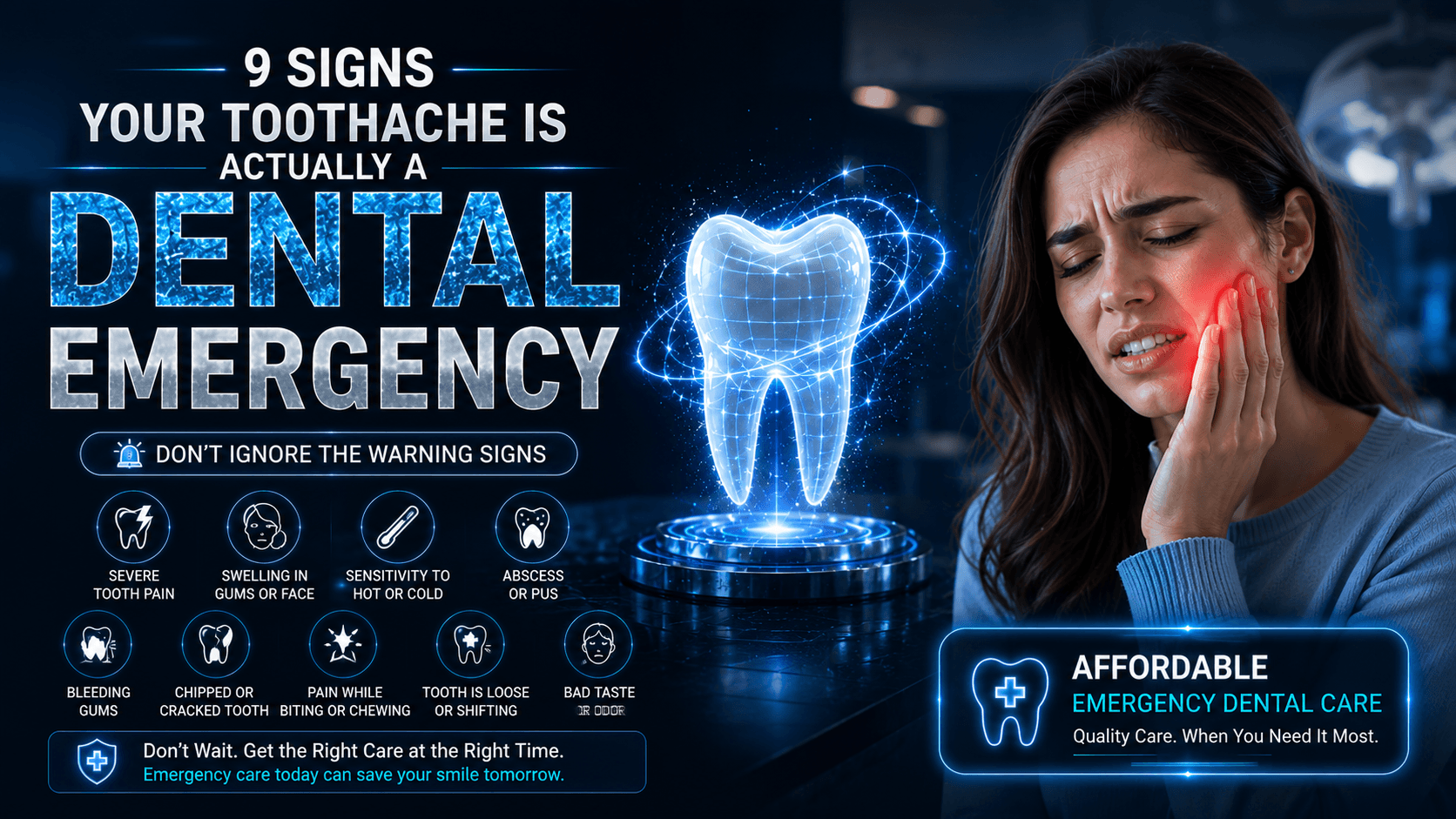
Most people sit with tooth pain longer than they should. They take an ibuprofen, rinse with warm salt water, and tell themselves it'll pass. Sometimes it does. Often, it doesn't, and waiting turns a manageable problem into something that requires far more time, money, and discomfort to fix.
Not every toothache needs emergency care. But some absolutely do. And the difference isn't always obvious until you know what to look for. If you're searching for affordable emergency dental care and aren't sure whether your pain qualifies, this is the guide to read before you wait another day.
Pain That Wakes You Up At Night
Mild daytime sensitivity is one thing. Pain that pulls you out of sleep is another.
Dental pain that intensifies when you lie down, or worse, wakes you mid-sleep, usually signals that inflammation has reached the pulp of the tooth. The pulp houses the nerve. Once the nerve is involved, the pain isn't coming and going on a whim. It's progressing. That's not something rest or over-the-counter pain relief resolves long-term.
Swelling In Your Jaw, Cheek, Or Neck
Swelling outside the mouth deserves immediate attention. Full stop.
Facial swelling near the jaw, under the chin, or along the neck can indicate a spreading dental abscess. Abscesses are bacterial infections that don't stay contained. When one spreads beyond the tooth into surrounding tissue, it becomes a genuine medical risk, not just a dental one.
- Swelling that developed quickly (within hours) is more urgent than swelling that appeared slowly
- If the swelling makes it difficult to swallow or breathe, go to an emergency room, not a dental office
- A hard, warm lump along the gumline near a painful tooth almost always signals infection
This isn't the category where you wait until Monday.
A Tooth That Got Knocked Loose Or Completely Out
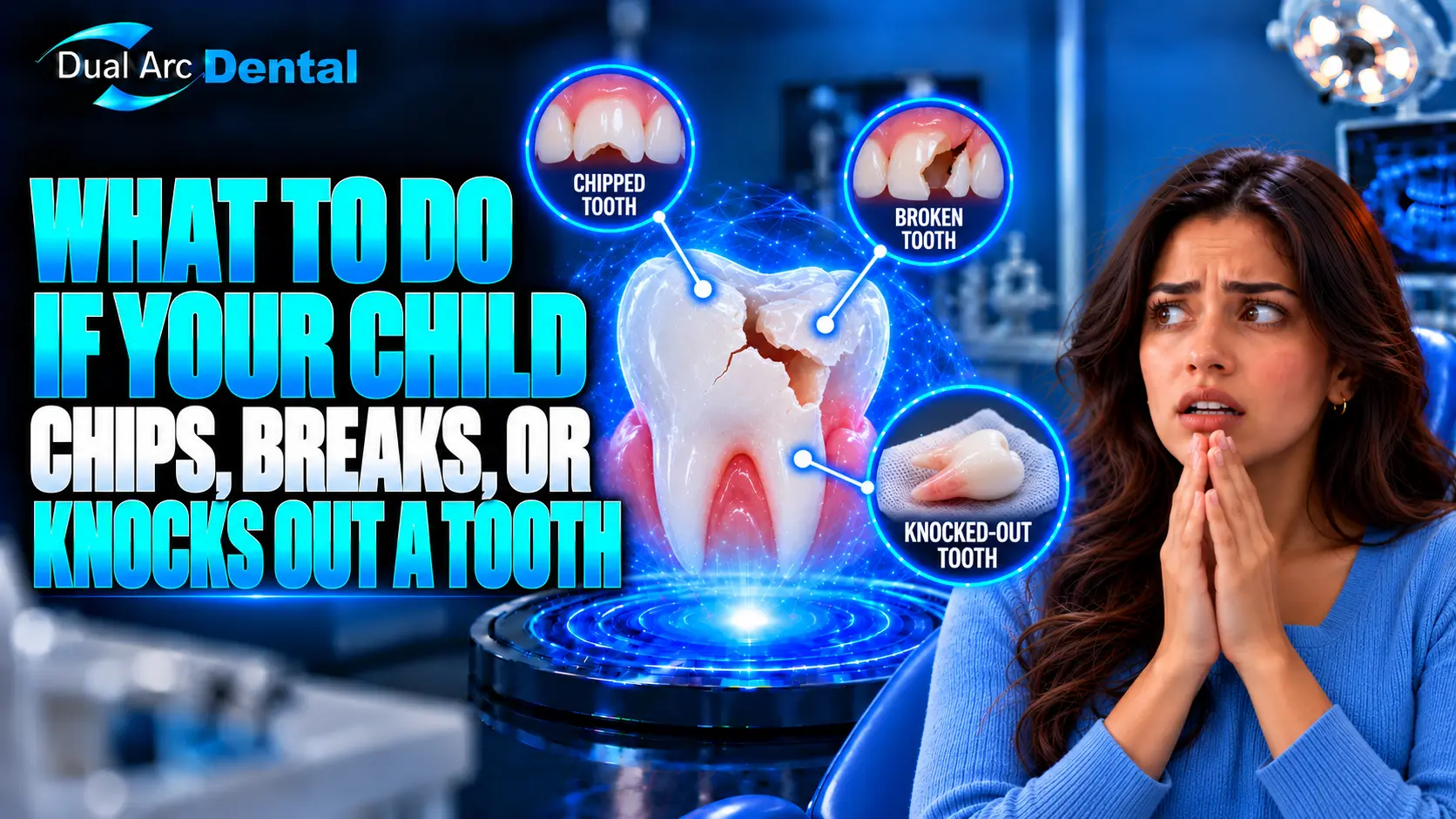
Knocked-out teeth have a narrow window for reimplantation. If an adult tooth gets fully displaced, you have roughly 30 to 60 minutes to reach a dental office before the likelihood of successful reimplantation drops sharply.
What to do immediately:
- Pick the tooth up by the crown, not the root
- Rinse gently with clean water, don't scrub
- If possible, place it back in the socket or keep it between your cheek and gum
- If that's not possible, store it in a small cup of milk or saliva
A loose tooth that hasn't come out still needs same-day evaluation. The supporting structures can sometimes be stabilised if treated quickly enough.
Severe, Throbbing Pain That Doesn't Let Up
There's a difference between tooth sensitivity and throbbing pain. Throbbing usually means one thing: infection.
Pain that pulses, won't respond to normal pain relief, and has been worsening over 24 to 48 hours is not something to manage at home. The body is signalling that something is actively wrong. Dental infections don't improve without professional treatment, and some of them spread faster than people expect.
Visible Pus Or A Pimple-Like Bump On Your Gums
A dental abscess sometimes forms a small, pimple-like bump on the gumline near the affected tooth. This is called a fistula, and it's a drainage tract for infection. It sounds harmless. It's not.
Even when a fistula reduces pressure and temporarily decreases pain, the infection underneath is still active. Draining on its own doesn't mean clearing on its own. You still need treatment to eliminate the source.
Persistent Bleeding That Won't Stop
Some bleeding after biting something hard or flossing aggressively is normal. Bleeding that doesn't stop within 10 to 15 minutes, or that started without an obvious cause, is worth a call to your dentist.
Post-extraction bleeding that continues for more than an hour despite applying pressure is a clear reason to seek affordable emergency dental care the same day. Bleeding gums that have worsened over days, especially alongside pain or swelling, can indicate infection or a more serious underlying issue.
Numbness Replacing Your Pain
This one surprises people. If a toothache that was intense suddenly becomes numb, that's not the tooth healing. It's usually a sign the infection has killed the nerve.
Dead nerve tissue doesn't hurt. But the infection causing it doesn't disappear. It keeps spreading into surrounding bone and tissue while the pain signal that was warning you goes quiet. People often feel relieved at this point. They shouldn't.
A Broken Or Cracked Tooth That's Causing Pain
Not all cracked teeth hurt. But when one does, especially with sharp pain on biting, or lingering sensitivity to temperature, there's a good chance the fracture has reached the inner layer of the tooth.
- Craze lines (surface cracks) rarely need emergency care
- Fractured cusps can sometimes wait a day or two
- Cracks that extend toward the root, or that expose the pulp, need same-day evaluation
The tricky part: you usually can't tell which kind you're dealing with without an X-ray. When in doubt, get it checked.
Severe Sensitivity To Hot Or Cold That Lingers
Brief sensitivity to a cold drink is common, especially in older teeth. What's not normal is sensitivity that lingers for 30 seconds or more after the temperature source is removed.
Lingering cold sensitivity often points to pulpitis, inflammation of the pulp tissue. It can be reversible in early stages. Left untreated, it typically isn't. Hot sensitivity that produces prolonged pain is often a sign the nerve is already compromised.
These are the kinds of symptoms that feel minor until they aren't. Catching them early is genuinely easier and less expensive than treating them after the infection has set in.
The Uncomfortable Truth About Waiting
Dental problems don't plateau. They either get treated or they get worse. A small cavity ignored becomes a root canal. An abscess ignored becomes a systemic infection. A cracked tooth ignored becomes an extraction. The cost, financial and physical, scales with delay.
This isn't meant to alarm anyone. It's just honest. The patients who come in when something first feels wrong consistently have better outcomes than those who push through for weeks hoping things resolve on their own.
When Something Feels Wrong, Don't Wait
At Dual Arc Dental in Schertz, TX, Dr. Viral Patel and Dr. Vaidehi Mehta offer same-day appointments for dental emergencies and are committed to providing affordable emergency dental care that doesn't make patients choose between cost and their health. If any of the signs above sound familiar, call the office at (210) 375-5256 or book directly online, because the right time to address a dental emergency is always now.
FAQs
1. How can I tell if my toothache is a dental emergency?
A toothache may be a dental emergency if it is severe, persistent, accompanied by swelling, fever, uncontrolled bleeding, or follows a dental injury. Pain that interferes with sleeping or is getting worse instead of improving should also be evaluated promptly by a dentist.
2. Can I wait a few days before seeing a dentist for a severe toothache?
If the pain is intense, worsening, or accompanied by swelling, pus, or difficulty chewing, it's best not to wait. Delaying treatment can allow the underlying problem to progress, potentially leading to more complex and costly care.
3. What should I do if I knock out a permanent tooth?
Handle the tooth by the crown rather than the root, gently rinse it if necessary, and try to place it back into the socket. If that isn't possible, store it in milk or saliva and seek emergency dental care immediately, as prompt treatment offers the best chance of saving the tooth.
4. Is facial swelling from a toothache always serious?
Facial swelling can indicate that an infection has spread beyond the tooth and should be assessed as soon as possible. If the swelling is severe or is causing difficulty breathing or swallowing, seek emergency medical care immediately.
5. Can an emergency dentist treat a cracked or broken tooth on the same day?
In many cases, yes. Emergency dentists can evaluate the extent of the damage, relieve pain, and provide immediate treatment or temporary protection until a permanent restoration can be completed.