

Veneers vs Whitening: Which One Actually Gives the Smile You Want?
Most people searching this question already have a preference. They've seen a before-and-after somewhere, or a friend mentioned what they got done, or they've been looking at their smile in the front camera long enough that they've decided something needs to change.
What they're not always sure about is whether the thing they're leaning toward is actually the right fit for the problem they have.
That distinction matters more than most cosmetic dentistry content acknowledges. Veneers and whitening are not interchangeable options sitting at different price points. They solve different problems. Choosing the wrong one means spending money on something that either can't fix what you're seeing or fixes it in a way that doesn't last.
Here's how to think through it.
What Whitening Actually Does And What It Can't?
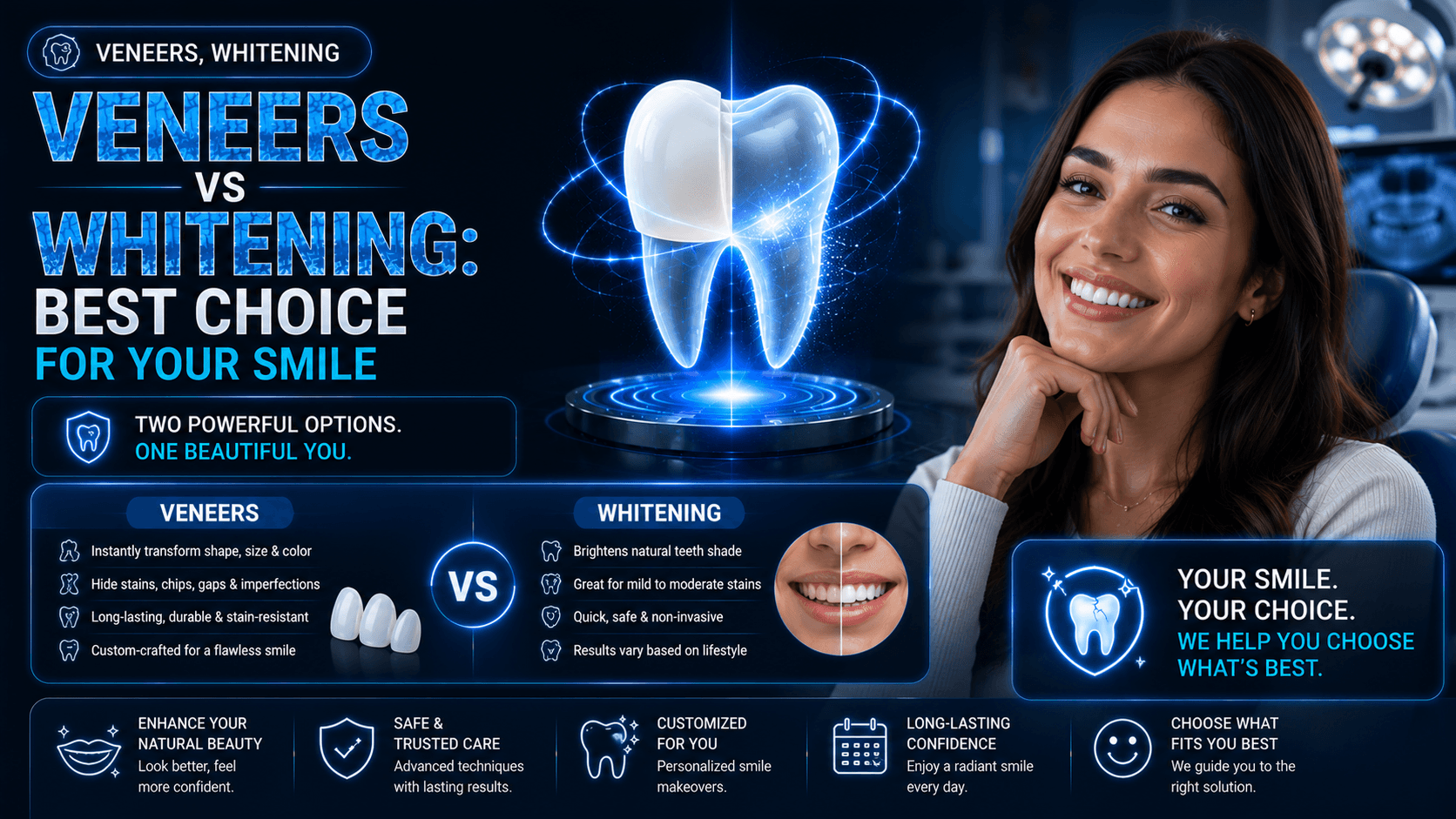
Professional whitening works on intrinsic tooth colour. The bleaching agent penetrates enamel and breaks apart the molecular chains of stain compounds sitting within it. The tooth gets lighter. For patients whose main concern is discolouration from coffee, wine, tea, or years of surface staining, the results are real and often dramatic.
The ceiling is the natural colour of your enamel.
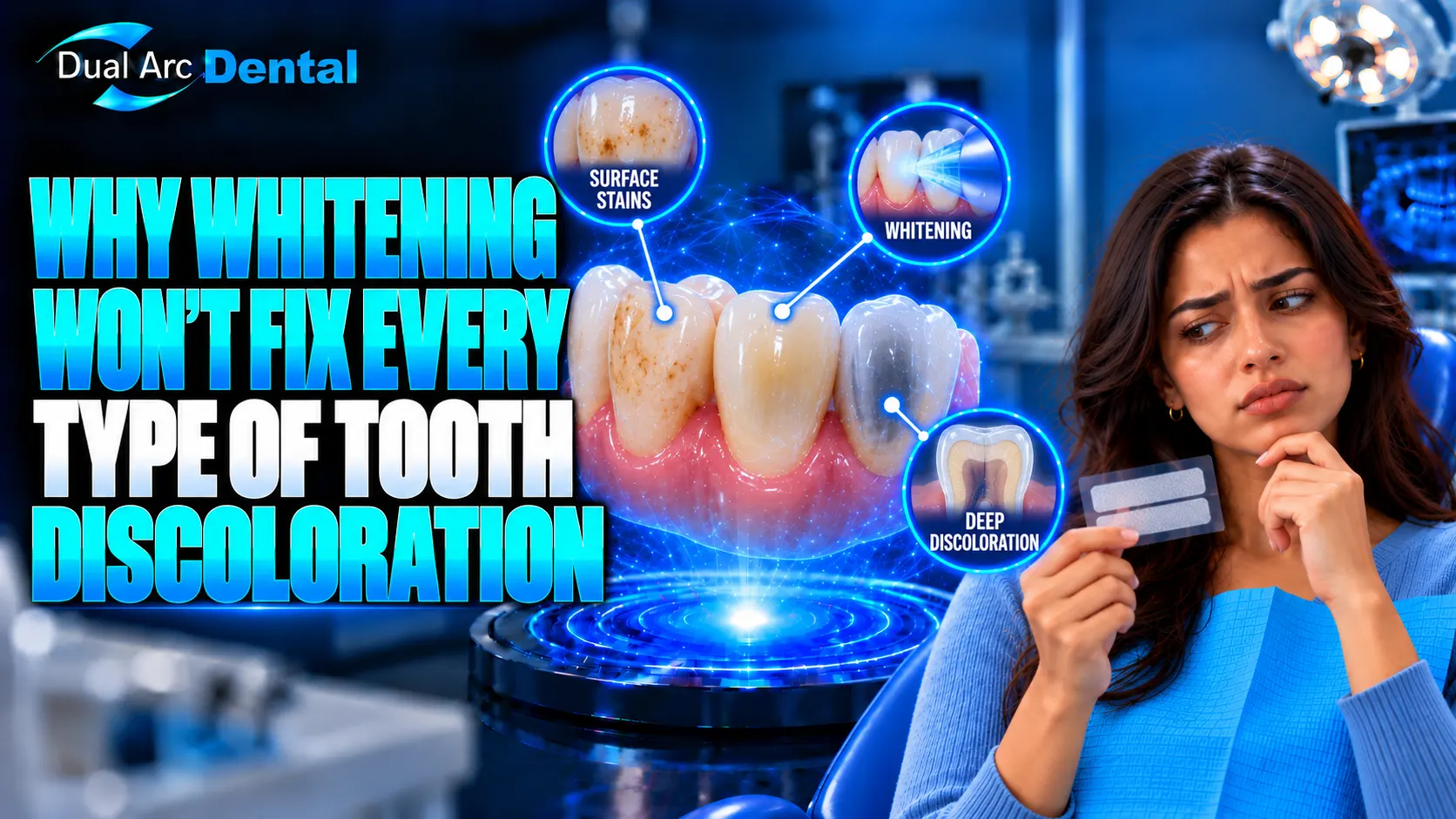
Whitening cannot go lighter than the tooth's baseline shade. It cannot change the shape of teeth. It cannot close gaps, fix chips, or address uneven edges. And it has no effect on certain types of discolouration, tetracycline staining from antibiotics, fluorosis, or grey discolouration from internal trauma all fall outside what bleaching chemistry can reach.
Results also fade. Without maintenance, touch-up trays, periodic in-office treatments, and dietary discipline, most professional whitening results visibly diminish within one to three years, depending on the patient's habits.
The honest fit for whitening: patients with healthy, well-shaped teeth whose concern is shade, and who are willing to maintain the result over time.
What Veneers Actually Do, And What They Cost?
A veneer is a thin shell of porcelain bonded to the front surface of a tooth. It changes the tooth's appearance in every dimension simultaneously: colour, shape, length, symmetry. For patients whose concerns go beyond shade, chips, cracks, uneven sizing, gaps, slight misalignment that doesn't warrant orthodontics, veneers address all of it in a single restoration.
The results are permanent in the sense that matters most: porcelain doesn't stain the way enamel does. The colour achieved on day one stays stable for ten to twenty years with normal care. No touch-up schedule. No dietary restrictions beyond common sense.
The tradeoff is preparation. Getting veneers involves removing a thin layer of enamel from the tooth's surface before bonding. That's irreversible. The tooth will always need a veneer or some form of coverage going forward. Patients who are considering veneers on teeth that are otherwise healthy need to understand that clearly before committing.
Cost is also a real variable. A full set of veneers runs significantly higher than a whitening treatment. For patients whose concern is purely shade on otherwise healthy, well-shaped teeth, veneers are clinical overreach, spending more and removing tooth structure to solve a problem whitening handles cleanly.
The Questions That Actually Determine Which One Fits
Neither option is universally better. The right answer comes from asking the right questions about the specific situation.
What Exactly Bothers You About Your Smile?
If the answer is "my teeth are yellow," whitening is almost certainly the starting point. If the answer includes shape, chips, gaps, or asymmetry alongside colour, or if colour is the concern but the discolouration is the type that doesn't respond to bleaching, veneers become the relevant conversation.
How Permanent Do You Want The Result To Be?
Whitening requires maintenance. It fades and gets refreshed. Some patients are completely fine with that model, it's lower cost, lower commitment, and reversible. Others want to solve the problem once and not think about it again. Veneers suit the second type better.
Are Your Teeth Structurally Sound?
Veneers work best on teeth that are healthy underneath. Active decay, gum disease, or significant structural compromise needs to be addressed before any cosmetic work makes sense. A dentist who recommends veneers without first establishing that the teeth and gums are in good condition is getting the sequence wrong.
What's The Realistic Budget?
Whitening and veneers don't occupy the same financial category. If budget is a real constraint, whitening delivers significant aesthetic improvement at a fraction of the cost. If budget allows for veneers and the clinical situation calls for them, the permanence and comprehensiveness of the result justify the investment.
Conclusion
The most common mismatch: patients who want veneers because they've seen dramatic transformations online, when their actual concern, shade, is something professional whitening resolves completely. They'd spend more, remove healthy enamel, and get a result that whitening would have produced without the irreversibility.
The second most common: patients who whiten teeth that have chips, uneven edges, or noticeable gaps, then feel like the result still looks off. Brighter isn't always better if the shape is what the eye actually notices first.
The fix in both cases is the same: a clinical conversation before the decision, not after.
At Dual Arc Dental in Schertz, TX, Dr. Viral Patel and Dr. Vaidehi Mehta offer both professional whitening and veneers consultations, with the kind of honest assessment that puts patients in the right treatment rather than the more expensive one. Call (210) 375-5256 or book online, the right answer for your smile starts with the right conversation.
FAQs
1. How do I know if I need veneers or professional teeth whitening?
If your primary concern is stained or yellow teeth, professional whitening is often the best starting point. If you're also concerned about chips, gaps, uneven tooth shape, or worn edges, veneers may provide a more comprehensive cosmetic solution.
2. Do veneers stay white longer than professionally whitened teeth?
Yes. Porcelain veneers are highly resistant to staining and typically maintain their color for many years. Professional whitening results can also last a long time, but they usually require occasional touch-ups depending on your diet and oral hygiene habits.
3. Can teeth whitening fix chipped or uneven teeth?
No. Teeth whitening only changes the color of natural teeth. It does not repair chips, reshape teeth, close gaps, or correct uneven edges. Those concerns generally require cosmetic treatments such as veneers or dental bonding.
4. Are veneers a permanent cosmetic treatment?
Yes. Veneers are considered a long-term treatment because a small amount of enamel is usually removed before they are placed. While veneers are durable, they may eventually need replacement after many years of normal use.
5. Can I whiten my teeth before deciding on veneers?
In many cases, yes. Dentists often recommend whitening first if discoloration is your main concern or if only a few teeth may need veneers. This approach can help determine whether whitening alone achieves your desired smile or if additional cosmetic treatment is needed.