

Do Root Canals Really Cause Health Problems? What the Evidence Says
Root canal treatment has been used for decades to preserve teeth affected by severe pulpal inflammation or infection. Yet claims still circulate that a treated tooth can somehow become a source of chronic illness elsewhere in the body. For patients searching for endodontics nearby, separating established dental evidence from outdated theories is important before deciding whether to preserve or remove a tooth.
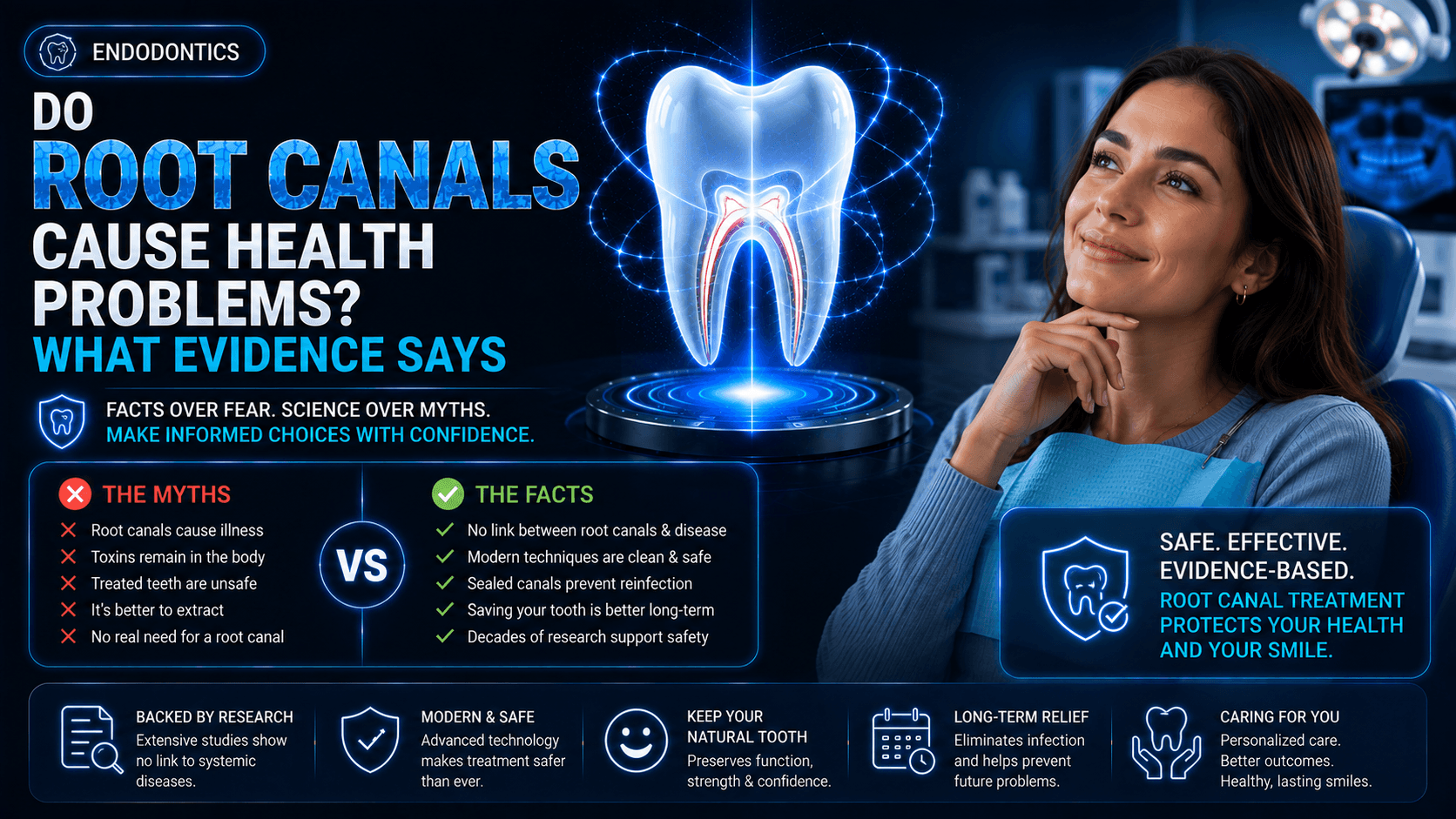
Modern endodontic treatment is based on eliminating infected or inflamed tissue from inside the tooth, disinfecting the root canal system and sealing it to reduce the opportunity for microorganisms to re-enter. Current evidence does not support the claim that a properly treated root canal causes systemic diseases simply because the tooth remains in the mouth.
Where Did the Root Canal Health Myth Come From?
Much of the concern can be traced back to the focal infection theory promoted during the early twentieth century.
At the time, some researchers proposed that bacteria trapped inside root-filled teeth could spread through the body and cause conditions affecting distant organs. This theory influenced dental treatment for a period, with extraction sometimes being preferred over retaining infected teeth.
The problem is that these early conclusions were based on experimental methods that would not meet modern scientific standards.
Subsequent research, improved microbiological techniques and decades of clinical experience have not established a causal relationship between properly performed root canal treatment and diseases such as arthritis, heart disease or cancer.
That distinction matters. Dental infection itself can have health consequences, but that is very different from claiming that correctly treated teeth cause systemic disease.
What Root Canal Treatment Actually Does
The dental pulp occupies the central chamber and root canals of a tooth. It contains nerves, blood vessels and connective tissue.
When deep decay, trauma, cracks or other problems allow bacteria to reach the pulp, the tissue may become irreversibly inflamed or infected. In some cases, the pulp eventually becomes necrotic.
Root canal treatment is designed to manage this disease process by:
- Removing inflamed, infected or necrotic pulp tissue
- Mechanically cleaning and shaping the root canal system
- Using disinfecting solutions to reduce microbial contamination
- Filling and sealing the prepared canals
- Restoring the tooth so it can continue functioning
For someone considering endodontics nearby, the objective is therefore not to leave infection sealed inside the tooth. The treatment is specifically performed to eliminate the source of pulpal disease as thoroughly as possible.
Can Bacteria Still Exist After a Root Canal?
No biological procedure can guarantee complete elimination of every microorganism.
Root canal systems are anatomically complex. They may contain lateral canals, fins and microscopic irregularities that cannot always be mechanically instrumented.
Modern endodontic techniques compensate for this through a combination of instrumentation, irrigation, disinfection and sealing.
A small number of microorganisms may occasionally persist or re-enter the tooth, which is one reason root canal treatment can sometimes fail. Failure, however, is a local clinical complication, not evidence that all root-treated teeth are hazardous to general health.
If infection persists, appropriate options may include retreatment, endodontic surgery or extraction depending on the individual case.
What About Claims Linking Root Canals to Cancer or Heart Disease?
There is no reliable evidence demonstrating that root canal treatment causes cancer.
Similarly, current evidence does not establish root-filled teeth as a direct cause of cardiovascular disease, autoimmune disorders or other chronic systemic illnesses.
Some confusion arises because oral health and general health can influence one another. Chronic inflammation, periodontal disease and untreated infections have been studied in relation to wider health outcomes.
But association is not the same as causation.
It is scientifically inaccurate to take evidence showing relationships between poor oral health and certain systemic conditions and use it to conclude that root canal treatment itself creates those diseases.
Patients looking for endodontics nearby should therefore base treatment decisions on current diagnostic findings and recognised clinical evidence rather than unsupported claims.
Is Extraction Safer Than Root Canal Treatment?
Not automatically.
Extraction removes the affected tooth completely, while endodontic treatment aims to retain the natural tooth when doing so is clinically appropriate.
Each option has indications, limitations and potential complications. Removing a restorable tooth solely because of fear that root canal treatment causes systemic illness is not supported by current evidence.
A dentist should instead evaluate:
- How much healthy tooth structure remains
- Whether the tooth can be predictably restored
- The extent of infection or inflammation
- Periodontal support around the tooth
- Previous dental treatment
- The patient's overall treatment requirements
The goal is to select the option with the most appropriate prognosis for that particular tooth.
When Can a Root-Canal-Treated Tooth Cause Problems?
A treated tooth can occasionally develop complications.
Symptoms such as persistent pain, recurrent swelling, tenderness or drainage may indicate residual or recurrent infection, structural damage or another dental problem.
These symptoms deserve reassessment. They do not mean that root canal treatment is inherently dangerous.
Follow-up examination and dental imaging can help determine whether the tooth is healing as expected or requires additional treatment.
Make Treatment Decisions Based on Evidence
The available evidence does not support the idea that properly performed root canal treatment causes chronic systemic disease. Endodontic treatment remains an established method of managing diseased pulp tissue and preserving natural teeth when appropriate.
Dual Arc Dental provides endodontics nearby for patients in Schertz who require evaluation and treatment of infected or damaged teeth. The dental team can assess whether root canal therapy is appropriate and explain the available treatment options based on the condition of the tooth.
Frequently Asked Questions
1. Can a root canal cause cancer?
Current scientific evidence does not demonstrate that root canal treatment causes cancer. Claims suggesting such a link are largely based on outdated theories that are not supported by modern research.
2. Can an infected tooth affect general health?
Untreated dental infections can sometimes spread beyond the tooth and may contribute to broader health complications. This is one reason timely diagnosis and treatment are important.
3. Can a root canal fail?
Yes. Persistent bacteria, reinfection, complex root anatomy, structural damage or problems with the restoration can occasionally cause treatment failure. Retreatment or another procedure may then be considered.
4. Is it healthier to extract a tooth instead of having a root canal?
Not necessarily. If a tooth is restorable, root canal treatment may allow it to remain functional. Extraction is appropriate in some situations, but it should be based on clinical factors rather than unsupported systemic health claims.
5. How do I know if a previously treated tooth needs reassessment?
Persistent pain, swelling, tenderness when biting, drainage or new changes around a treated tooth should be evaluated by a dentist. Dental examination and imaging can help identify the cause.