

Why Does Everyone Fear Root Canals When Modern Dentistry Has Changed?
Ask someone if they'd rather get a root canal or sit through three hours of work meetings and a surprising number will pick the meetings.
That says something, not about meetings, but about how deeply the fear of a root canal nearby has embedded itself into how people talk about dental care. It shows up in idioms. In jokes. In the first thing people say when you mention you're going to the dentist. The dread is cultural at this point, passed down through stories from parents and grandparents who genuinely had difficult experiences in an era when the procedure looked nothing like it does today.
The fear is real. The thing people are afraid of mostly isn't.
Where The Reputation Came From
Root canals in the mid-20th century were a different clinical experience. Anaesthesia was less refined. The instruments used to clean the canals were manual files, worked by hand, through curved and narrow anatomy. The procedure took multiple appointments. Patients were sometimes treated while still experiencing significant sensation. Recovery was rougher.
That era produced real stories. Those stories got told. And they calcified into a collective fear that outlived the circumstances that created it by decades.
The dentistry has changed. The story hasn't caught up.
What The Procedure Actually Involves Now
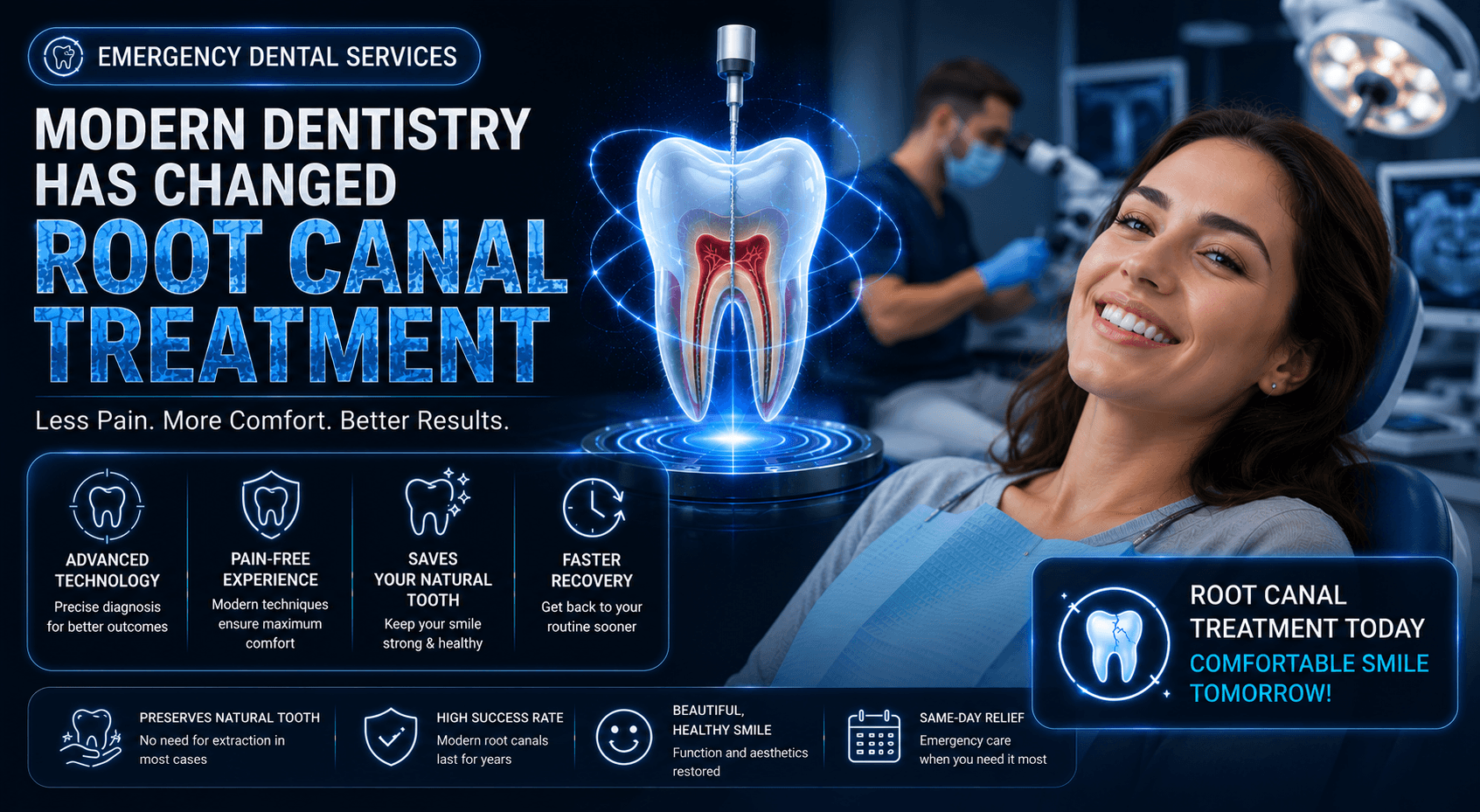
Aroot canal today is, in clinical terms, a filling that goes deeper. The dentist numbs the area properly, completely removes the infected or inflamed tissue from inside the tooth, cleans and shapes the canals, fills them, and seals the tooth. Then a crown goes on top.
Most patients report the procedure feels like a longer filling appointment. Not painless, there's pressure, there's sound, there are moments of discomfort. But the nerve pain that patients fear, the sharp and overwhelming sensation of the old stories, is what anaesthesia is specifically designed to prevent. A well-administered block means the nerve isn't transmitting pain signals during the procedure.
A 2016 survey published in the Journal of Endodontics found that patients who had actually undergone a root canal rated their experience as significantly less painful than patients who had never had one but were anticipating it. The fear of the procedure, in other words, is measurably worse than the procedure itself.
What people experience going in is dread. What they experience coming out is usually relief, because the infection that was causing their pain is gone.
The Specific Things That Have Actually Changed
It's worth being concrete here, because "modern dentistry" is a vague phrase that doesn't mean much without specifics.
Anesthesia Delivery
Buffered anaesthetics work faster and more evenly than older formulations. Dentists now have better techniques for numbing teeth that are acutely infected, historically one of the trickier clinical problems, because infected tissue resists standard anaesthesia more than healthy tissue does.
Rotary Instrumentation
Manual filing has been replaced almost entirely by rotary nickel-titanium instruments that clean the canals faster, more thoroughly, and with less chair time. A procedure that once took two or three appointments often completes in one.
Digital Imaging
Cone beam CT scans give dentists a three-dimensional view of the root anatomy before they begin. Missed canals, one of the main reasons root canals historically failed, are far less common when the dentist can see the full canal system in advance.
Sedation Options
For patients with genuine dental anxiety, minimal oral sedation is available. The procedure happens while the patient is relaxed and largely disconnected from the experience. They remember little. Recovery from the sedation is mild.
None of these are recent developments. They've been standard practice for years. The problem is that public perception of the procedure is still running on a version of it that no longer exists.
The Real Cost Of The Fear
Here's where the mythology does actual damage.
Patients who are afraid of a root canal nearby avoid the dentist when symptoms start. They manage pain with over-the-counter medication and hope the situation resolves. It rarely does. By the time they come in, the infection has advanced, the tooth has sometimes fractured, and the options have narrowed from a straightforward root canal to something more involved, or to extraction.
The fear of a procedure that takes one appointment and causes manageable discomfort leads people directly toward outcomes that are more expensive, more involved, and more genuinely painful. That's the real cost of a reputation that hasn't updated.
Avoiding the thing you're afraid of doesn't make it smaller. In dentistry, it makes it bigger.
What Patients Who've Actually Had One Say
The most consistent thing patients report after a root canal isn't that it was fine. It's that they can't believe they waited as long as they did. The procedure they dreaded for weeks was less of an event than they'd built it into. The relief afterwards, tooth saved, infection gone, pain resolved, was immediate.
That pattern repeats constantly. The anticipation is always worse than the appointment.
At Dual Arc Dental in Schertz, TX, Dr Viral Patel and Dr Vaidehi Mehta handle root canals with the kind of care that makes anxious patients wonder why they waited. If you've been putting off a tooth that needs attention because the words root canal nearby make you want to close the browser tab, call (210) 375-5256. One conversation changes the picture entirely.
FAQs
1. Is getting a root canal painful with modern dentistry?
Modern root canal treatment is typically no more uncomfortable than having a dental filling. Local anesthesia effectively numbs the area, and most patients experience pressure rather than pain during the procedure. In many cases, the treatment relieves the tooth pain caused by infection.
2. Why would I need a root canal?
A root canal is recommended when the pulp inside a tooth becomes infected or severely inflamed due to deep decay, a crack, repeated dental procedures, or trauma. The treatment removes the infection while preserving the natural tooth whenever possible.
3. How long does a root canal procedure take?
Many root canals can be completed in a single visit lasting about 60 to 90 minutes, although more complex cases may require an additional appointment. Your dentist will recommend the best approach based on the condition of your tooth.
4. Is it better to get a root canal or have the tooth extracted?
Whenever possible, saving your natural tooth is generally the preferred option. A root canal preserves your natural bite and helps prevent nearby teeth from shifting. However, if the tooth cannot be restored, extraction may be the more appropriate treatment.
5. How long does a tooth last after a root canal?
With proper restoration, good oral hygiene, and regular dental checkups, a tooth treated with a root canal can often last for many years or even a lifetime. A crown is commonly recommended to protect the tooth and restore its strength.