
What Happens If You Skip Dental Cleanings for Five Years?
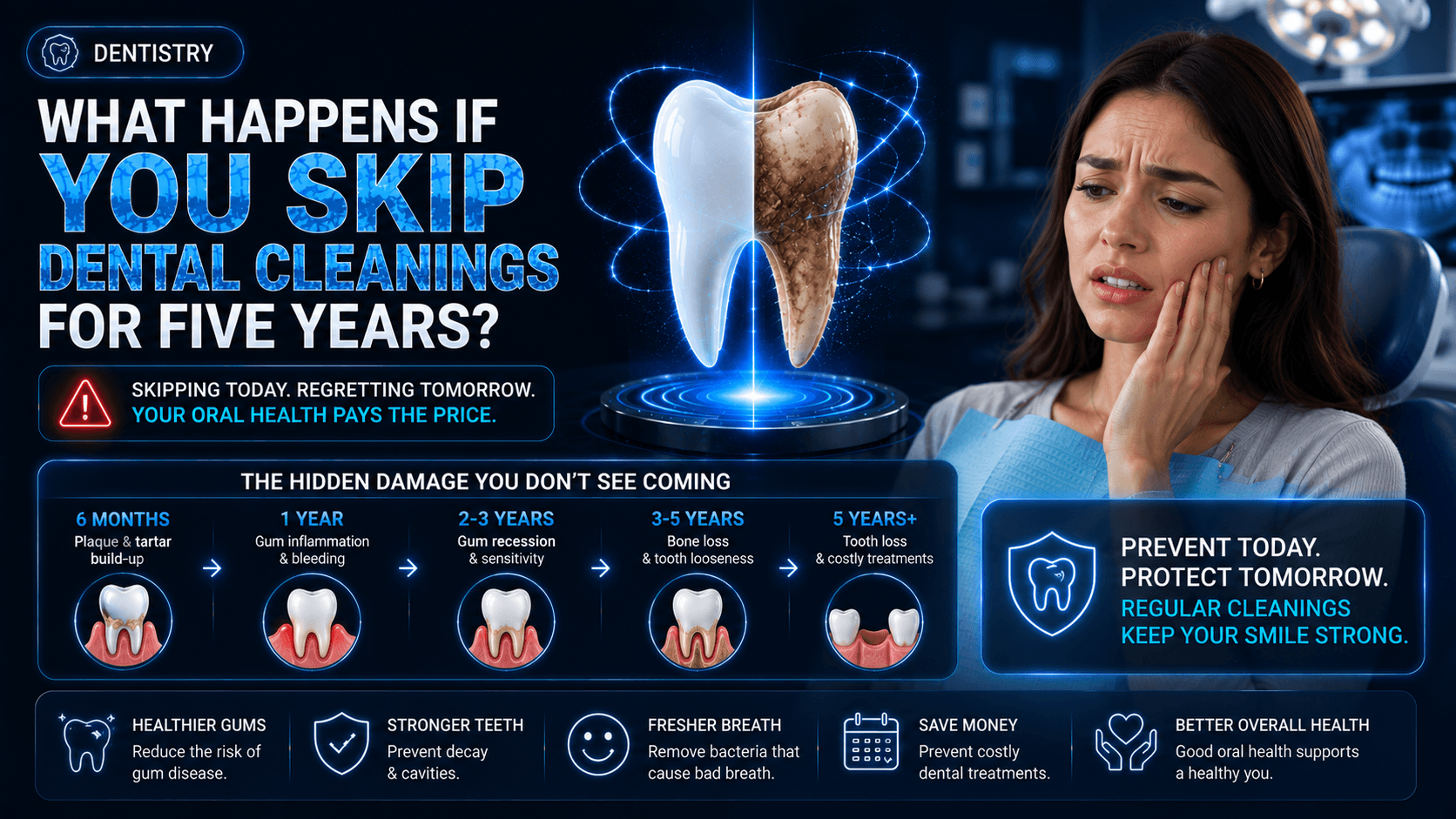
Five years sounds like a long time until you're the person in the chair explaining to a dentist that you haven't been in since before the pandemic. Then it feels like an embarrassing blink.
It's more common than people admit. Life gets busy, insurance lapses, the anxiety about what the dentist might find becomes its own reason to stay away. The longer the gap, the more the visit feels like walking into a judgment, and the easier it becomes to push it out another season.
But the mouth doesn't pause while you're away. And the five-year version of what was happening in there on year one is usually a different conversation entirely.
Here's what actually accumulates in that window, and why finding the best dentist in Schertz, TX sooner rather than later changes what the next decade of your dental health looks like.
Year One: The Buildup You Can't Remove At Home
Plaque is soft. Brushing and flossing clear most of it. What brushing doesn't reach, between teeth, just below the gumline, in the grooves of molars, hardens into tartar within 24 to 72 hours of forming. Tartar is calcified. No toothbrush removes it. No water flosser clears it. Only a dental instrument does.
After twelve months without a cleaning, tartar deposits have established themselves in the spots that matter most: the margin where the tooth meets the gum, and the narrow pockets between teeth and gum tissue. The gums around those deposits are irritated. They bleed when touched. Most people assume the bleeding means they're brushing too hard. They back off. The deposits grow undisturbed.
This is gingivitis. Entirely reversible at this stage. One cleaning, better home care, problem solved.
The window for "reversible" doesn't stay open indefinitely.
Years Two And Three: When The Gums Start Losing Ground
Gingivitis left unaddressed becomes periodontitis. That's not a terminology upgrade, it's a structural change. The infection moves from the gum tissue into the ligaments and bone that hold teeth in place.
Pockets form between the gum and the tooth root. Bacteria colonise those pockets. The immune system responds to the bacteria by breaking down tissue, not just infected tissue, but the surrounding bone as well. Bone loss in the jaw is permanent. It doesn't regenerate on its own.
At this stage, a standard cleaning isn't enough. A deep cleaning, scaling and root planing, done in quadrants, sometimes over multiple appointments, is what the situation requires. It takes longer, costs more, and involves more recovery than a routine visit would have at the twelve-month mark.
The infection is also no longer local. Research from multiple institutions, including the American Heart Association, has linked periodontitis to elevated systemic inflammation, with associations to cardiovascular disease, poorly controlled diabetes, and adverse pregnancy outcomes. The mouth connects to everything.
Years Four And Five: The Teeth Themselves Are In The Conversation Now
By year four or five, patients who skipped cleanings are dealing with compounding problems. The cavities that were small enough to catch with a routine X-ray at year one have had time to reach the pulp. What was a two-surface filling is now a root canal discussion. Sometimes a crown. Sometimes extraction, depending on how far the decay progressed and whether the tooth structure is still restorable.
Gum recession makes the picture more complicated. When gum tissue recedes due to chronic inflammation, it exposes the root surfaces of teeth. Root surfaces have no enamel; they decay faster and more painfully than the crown of the tooth. Cold sensitivity that seemed minor becomes a daily problem.
And the bone loss that started in year two or three has now advanced far enough that some teeth are noticeably looser than they were. Not falling out, but no longer anchored the way they should be.
A five-year gap doesn't always produce all of these outcomes. Genetics matter. Diet matters. Home care matters enormously. Some patients skip cleanings for years and come back with manageable situations. Others hit every checkbox on the list above.
The unpredictability is itself the problem. You don't know which category you're in until someone looks.
The Part People Don't Expect
Coming back after a long gap is almost never as bad as patients anticipate.
Dentists see long gaps constantly. Nobody in the chair is getting lectured. The clinical priority is assessing where things stand and building a plan, not cataloguing what went wrong or making the patient feel worse about waiting. A good office makes the re-entry easy, not an event.
What patients do experience is a longer first appointment. More X-rays. Potentially a gum assessment. A more thorough cleaning than a routine visit. And a conversation about what needs attention and in what order.
That's it. No catastrophe. Just dentistry getting done.
Conclusion
Not every problem from a five-year absence is reversible. That's the honest answer.
Bone doesn't come back. Enamel doesn't regrow. A tooth that gets extracted because it was too far gone at the five-year mark is a gap that now needs an implant or bridge, adding time, appointments, and cost that a cavity treated in year one would never have generated.
Routine cleanings aren't a product dental offices sell. They're the mechanism that keeps small, inexpensive problems from becoming large, expensive ones. Skipping them doesn't pause the process, it just removes the checkpoints.
At Dual Arc Dental in Schertz, TX, Dr Viral Patel and Dr Vaidehi Mehta see patients at every stage, including the ones who haven't been in for years and aren't sure what to expect. No judgment. Just an honest assessment and a clear plan. If you're looking for the best dentist in Schertz, TX to help you get back on track, call (210) 375-5256 or book online today.
FAQs
1. What happens if I don't get a professional dental cleaning for several years?
Skipping dental cleanings allows plaque and tartar to build up, increasing the risk of cavities, gum disease, bad breath, and tooth loss. The longer the gap, the more likely you are to need more extensive treatment than a routine cleaning.
2. Can brushing and flossing replace professional dental cleanings?
No. Daily brushing and flossing are essential, but they cannot remove hardened tartar. Professional cleanings use specialized instruments to remove deposits that cannot be eliminated with home care alone.
3. Is it too late to see a dentist if I haven't had a cleaning in years?
It's never too late to return for dental care. Dentists regularly treat patients who have gone several years without a visit and will evaluate your oral health, recommend appropriate treatment, and help you get back on a healthy routine.
4. How often should I schedule professional dental cleanings?
Most people benefit from a dental cleaning every six months, although some patients with gum disease or other oral health concerns may need more frequent visits. Your dentist can recommend the schedule that's right for you.
5. Will I always need a deep cleaning after skipping dental visits?
Not necessarily. Whether you need a routine cleaning or a deep cleaning depends on the amount of plaque and tartar buildup, the health of your gums, and whether gum disease is present. A dental examination will determine the most appropriate treatment.