

What Happens If You Ignore a Cracked Tooth for 30 Days?
Thirty days is nothing until it's everything.
A cracked tooth rarely announces itself with screaming pain on day one. It starts subtle, a sharp twinge when you bite into something, a quick jolt of cold sensitivity that disappears in seconds. Easy to chalk up to nothing. Easy to push to the back of your mind between meetings, meals, and everything else life keeps adding to the list.
But inside that tooth, the timeline is moving whether you are or not.
Here's what actually happens during those 30 days, and why the patients who find a best dentist nearby in the first week walk out with dramatically better outcomes than the ones who wait until the tooth makes the decision for them.
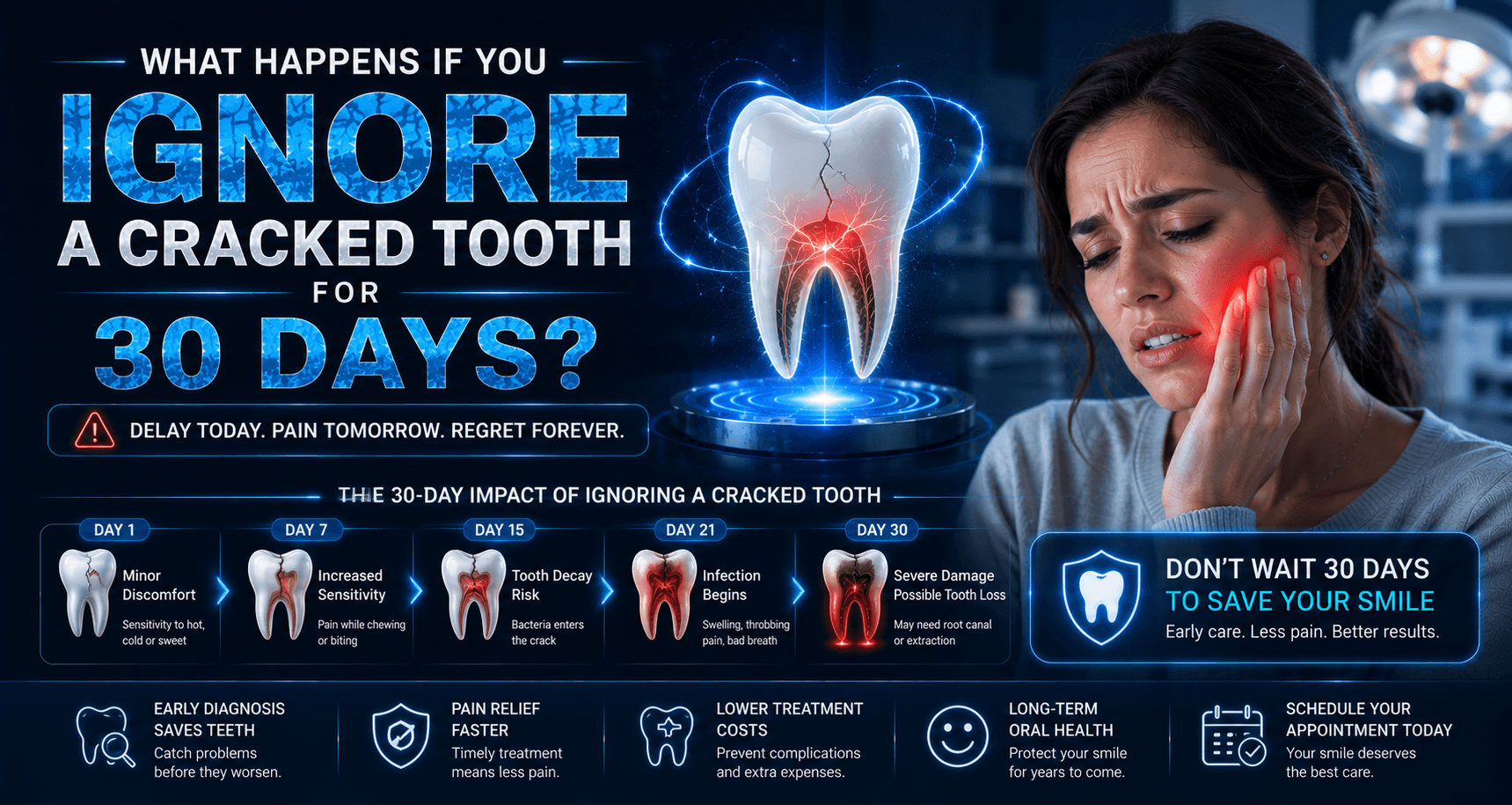
Days 1 Through 7: The Window Most People Waste
A cracked tooth in its earliest stage is often still restorable with a crown. The fracture hasn't reached the pulp, the inner chamber housing the nerve and blood vessels. Pain is intermittent. Biting a certain way triggers it; otherwise, the tooth feels almost normal.
That almost-normal is deceptive.
Every time you chew, the two sides of the crack flex slightly against each other. That movement widens the fracture, gradually, incrementally, in a way you can't feel happening. Dentists call this crack propagation. It doesn't need infection to progress. Chewing does it on its own.
A crown placed during this window stops that movement. It holds the tooth together, prevents the crack from deepening, and in most cases saves the tooth entirely. The procedure is straightforward. Recovery is minimal. Cost is manageable.
That window closes.
Days 8 Through 20: When The Nerve Gets Involved
If the crack reaches the pulp, the nature of the problem changes. The nerve is now exposed to bacteria, temperature, and pressure that it was never designed to handle directly. Pain becomes less predictable, sometimes sharp and sudden, sometimes a dull throb that lingers after eating.
At this point, a crown alone probably won't be enough. A root canal is now part of the conversation.
That's not a catastrophe. Root canals save teeth every day. But it's a longer appointment, a higher cost, and a more involved recovery than the crown that would have handled things a week or two earlier. Some patients who land here still feel uncertain about whether their tooth really needs treatment, the pain isn't constant, and absence of constant pain reads as absence of urgency.
It isn't. The infection is building between the signals.
Days 21 Through 30: The Point Where Options Start Disappearing
An untreated crack with pulp involvement becomes an abscess. Infection spreads from the pulp into the surrounding tissue, then into the bone beneath the tooth. Swelling shows up, sometimes at the gum line, sometimes in the jaw or cheek. The pain that was intermittent before is now persistent and harder to manage with anything over the counter.
This is also when the tooth structure itself becomes the problem. A fracture that's been widening for three to four weeks can split the tooth vertically, below the gum line. A split tooth can't be crowned. It can't be retreated. It gets extracted.
Extraction isn't the end of the world, it leads to implants, bridges, or other restorations. But it's a longer process, a higher total cost, and a gap in your mouth that affects bite alignment and adjacent teeth if it isn't addressed.
All of that from 30 days of waiting.
What Makes A Cracked Tooth So Easy To Dismiss
It doesn't look like anything. You can't see a crack in a tooth the way you'd see a cavity or notice a chip. Even X-rays don't always catch them, cracks run vertically, and standard imaging captures horizontal cross-sections.
The symptoms are also intermittent in a way that lets people rationalise. "It only hurts when I eat ice." "It's been like this for two weeks and hasn't gotten worse." Both things can be true, and the crack is still progressing underneath.
That's the trap. The tooth goes quiet between signals, and quiet feels like stability.
The Honest Math Of Waiting
Week one: crown, done. Week two to three: root canal, then crown. Week four and beyond: extraction, then implant or bridge, spread across months and multiple appointments.
The tooth that felt like a minor inconvenience in week one is a multi-step restoration project by week four. Finding an emergency dentist or walking into a dental office the first time you notice something is almost always the cheaper, faster, less painful path. Not because dentists say so, but because the biology of cracked teeth doesn't hold.
Don't Let The Tooth Decide For You
At Dual Arc Dental in Schertz, TX, Dr Viral Patel and Dr Vaidehi Mehta see cracked teeth at every stage, and the earlier the better. Same-day appointments are available for urgent cases. If something feels off, call (210) 375-5256 or book online. Being the best dentist nearby means being available when it matters, not just when it's convenient.
FAQs
1. How do I know if I have a cracked tooth?
Common signs include pain when biting, sensitivity to hot or cold foods and drinks, discomfort that comes and goes, or a rough edge you can feel with your tongue. Some cracks are not visible, so a dental examination is often needed for an accurate diagnosis.
2. Can a cracked tooth heal on its own?
No. Unlike bone, tooth enamel cannot repair itself once it has cracked. Without treatment, the crack may become larger over time, increasing the risk of infection, nerve damage, or tooth loss.
3. Is a cracked tooth always a dental emergency?
Not every cracked tooth requires immediate emergency treatment, but it should be evaluated as soon as possible. Prompt care gives your dentist the best chance of preserving the tooth and preventing the crack from worsening.
4. What treatments are available for a cracked tooth?
Treatment depends on the severity of the crack. Options may include dental bonding, a crown, root canal therapy, or, in cases where the tooth cannot be saved, extraction followed by a replacement option such as a dental implant or bridge.
5. What should I do if I think I have cracked a tooth?
Avoid chewing on the affected side, maintain good oral hygiene, and schedule a dental appointment promptly. Early diagnosis and treatment can help protect the tooth and reduce the likelihood of more extensive dental procedures later.