

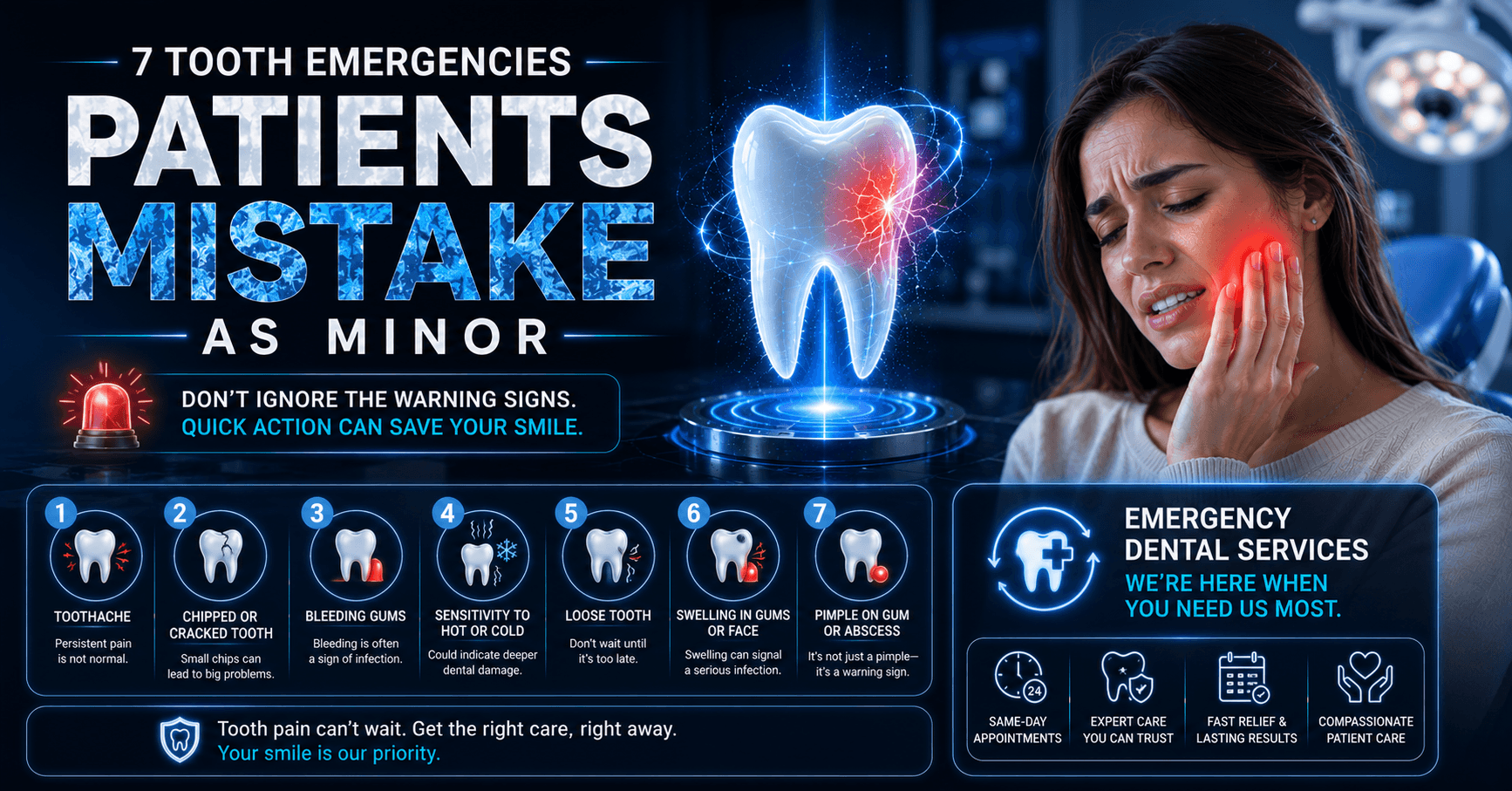
The 7 Tooth Emergencies That Patients Mistake as "Not That Bad"
Dental problems have a strange reputation for being tolerable. People who wouldn't ignore chest pain for three weeks will sit on a cracked tooth for two months. Part of that is cost anxiety. Part of it is the hope that things just resolve on their own.
Some do. Most don't.
The ones that don't tend to follow a pattern: they start as something that feels dismissible, then cross a threshold where the tooth structure, surrounding bone, or neighbouring teeth get pulled into a problem that started as one. By the time patients access emergency dental services, the options have narrowed.
These are the seven situations that look manageable from the outside but aren't.
1. A Tooth That's "Sensitive" But Not Painful
Sensitivity and pain are different sensations. Sensitivity, a brief, sharp jolt when you drink something cold or bite down, doesn't feel like an emergency. It feels like a nuisance.
But persistent temperature sensitivity that keeps coming back on the same tooth is the nerve talking. It means something has breached the outer layers of the tooth: a crack, advanced decay, or a failing filling. Caught now, a crown or filling replacement handles it. Left another few months, the nerve becomes infected, and the conversation shifts to a root canal or worse.
The tooth isn't hurting enough to demand attention. That's exactly what makes this one dangerous.
2. A Loose Crown That "Still Feels Okay"
A crown that's come loose hasn't just lost its grip, it's left the tooth underneath exposed. The prepared tooth beneath a crown has no enamel. It's dentin straight to the outside world, which means bacteria, temperature, and pressure reach it directly.
Patients often notice the crown feels slightly different but doesn't hurt, so they wait. What they're not seeing is the bacterial accumulation happening at the margin between the crown and the tooth. Recementing a loose crown is a ten-minute appointment. Treating the decay that develops underneath a neglected one is not.
3. Bleeding Gums That "Always Do This"
Gums that bleed during brushing aren't normal, even if they've been doing it for years. Chronic bleeding is a sign of gum disease, a bacterial infection of the tissue and, over time, the bone that holds teeth in place.
The earliest stages are reversible with a professional cleaning and better home care. The later stages aren't reversible at all. Bone loss from advanced gum disease is permanent. The teeth it was supporting become loose. Some get extracted.
"It's always been like this" is the exact history that puts people on a trajectory toward tooth loss they didn't see coming.
4. A Chipped Tooth That Doesn't Hurt
A chip with no pain reads as cosmetic. Maybe it is. Maybe the chip removed only enamel and the tooth is structurally sound underneath.
Or the chip exposed dentin, which means the nerve is now one bacterial infection away from direct involvement. Or the chip is the visible edge of a crack that runs deeper into the tooth than it looks. Or the rough edge is cutting the tongue and creating a wound that keeps reopening.
Without an X-ray and a clinical exam, there's no way to know which of those is true. What looks like a cosmetic issue from the outside is sometimes a fracture diagnosis waiting to be made.
5. A Tooth That "Ached For A Few Days" And Then Stopped Hurting
Pain going quiet is not healing. When a tooth that was intensely painful suddenly becomes numb or dull, the most likely explanation is that the nerve died.
Dead nerve tissue doesn't generate pain signals. The infection that killed it is still there, still active, still working its way through the surrounding tissue and bone. The body stopped reporting the problem. The problem didn't stop.
This one ends in an abscess if it goes untreated. Abscesses in the jaw can spread faster than people expect, and emergency dental services at that stage involve more than just the tooth
6. A Small Bump On The Gum Near A Tooth
Most patients who notice a small pimple-like bump on their gum either ignore it or assume it'll clear up. It usually doesn't hurt. It comes and goes.
That bump is a fistula, a drain for an abscess. The infection underneath is building pressure, the bump opens to relieve it, and the cycle continues while the underlying infection keeps expanding. The bump disappearing isn't the infection clearing. It's just pressure dropping temporarily.
One dental X-ray makes the diagnosis. Leaving it means letting the infection work deeper into bone.
7. Jaw Pain That "Might Just Be Stress"
Jaw pain has a few plausible explanations, tension, clenching, TMJ issues. Most people cycle through those explanations before they consider a dental cause. That's reasonable.
What's less reasonable is staying with that explanation for months when the pain is localised near a specific tooth, worsens with chewing, or comes with any swelling at all. A dental abscess that's developed near the jaw joint can feel indistinguishable from tension-related jaw pain until it doesn't.
Localised jaw pain near a tooth deserves a clinical exam, not just a night guard assumption.
The Shared Logic Across All Seven
None of these feels like emergencies at the start. That's the point. The situations that become genuinely damaging are almost always the ones that got a pass in the early window, when treatment was fast, affordable, and effective.
At Dual Arc Dental in Schertz, TX, Dr Viral Patel and Dr Vaidehi Mehta offer same-day appointments for urgent cases and the kind of emergency dental services that actually catch problems at the stage where they're still simple. If something on this list sounds familiar, call (210) 375-5256 today.
FAQs
1. What dental symptoms should never be ignored?
Persistent tooth sensitivity, facial swelling, bleeding that won't stop, a loose tooth or crown, severe pain, gum swelling, or a pimple-like bump on the gums should all be evaluated by a dentist promptly. These symptoms may indicate underlying problems that can worsen without treatment.
2. Is a chipped tooth always a dental emergency?
Not necessarily. A small chip may only affect the enamel, but larger chips or those causing pain, sensitivity, or sharp edges should be examined as soon as possible. A dentist can determine whether the damage extends deeper into the tooth.
3. Why did my tooth stop hurting if the problem wasn't treated?
A sudden reduction in pain doesn't always mean the tooth has healed. In some cases, it may indicate that the nerve inside the tooth has died while the underlying infection continues to spread. A dental evaluation is important even if the pain disappears.
4. Can bleeding gums become a dental emergency?
Occasional minor bleeding may be caused by irritation, but frequent or persistent bleeding can be a sign of gum disease or another oral health problem. Early treatment can help prevent more serious complications, including bone loss and tooth loss.
5. When should I seek same-day emergency dental care?
You should seek same-day care if you have severe tooth pain, swelling, signs of infection, a knocked-out or loose tooth, uncontrolled bleeding, or a broken tooth causing significant discomfort. Prompt treatment can often prevent further damage and improve the chances of saving the tooth.