

Is Tooth Extraction Always the Faster Solution? What Patients Should Know
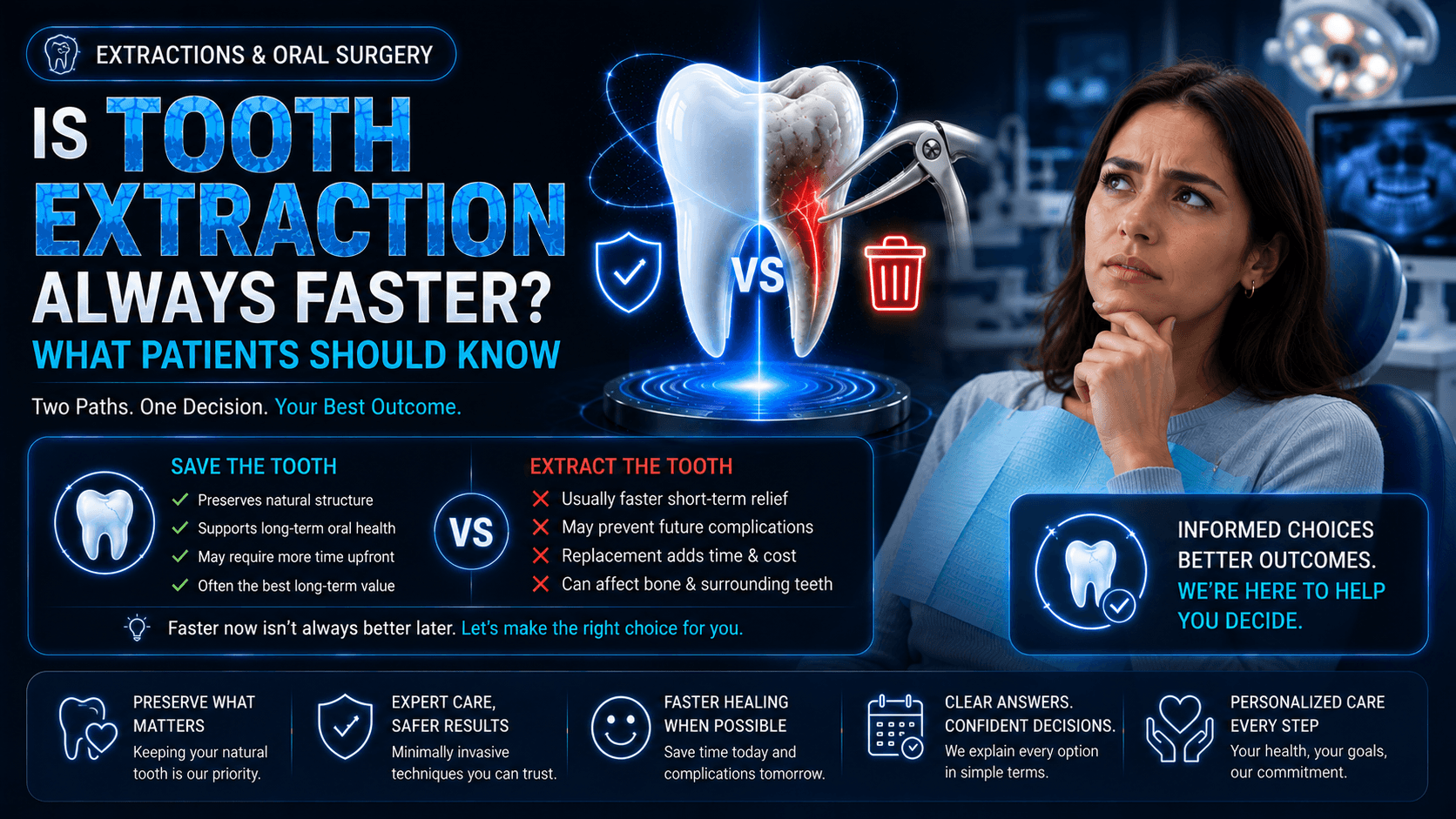
When a tooth is badly decayed, infected or causing persistent pain, removing it can appear to be the quickest way to end the problem. In certain clinical situations, tooth extraction is indeed the appropriate treatment. But “faster” is more complicated than how long a single appointment takes. The decision also needs to account for healing, future function, the condition of neighbouring teeth and whether the natural tooth can be predictably preserved.
For that reason, dentists generally assess the tooth first rather than treating extraction as the automatic answer to pain.
Extraction Solves One Problem but Creates Another Consideration
Removing a tooth eliminates that tooth from the mouth. If it is the source of infection or cannot be restored, this can be necessary.
The question is what happens afterwards.
With the exception of situations where replacement may not be necessary, losing a permanent tooth can leave a space that affects chewing, appearance or the way neighbouring teeth function. Depending on the individual case, replacing the missing tooth may later involve an implant, bridge or removable prosthesis.
So while removal itself may sometimes be relatively quick, the complete treatment pathway can extend well beyond the extraction appointment.
When Preserving a Tooth May Be Possible
A painful or infected tooth is not automatically beyond repair.
If there is sufficient healthy structure remaining and the supporting tissues are favourable, treatment may sometimes allow the natural tooth to remain functional.
For example, a tooth with irreversible pulp inflammation or infection may be considered for root canal treatment. The diseased pulp is removed, the internal canal system is cleaned and sealed, and the tooth is subsequently restored as clinically appropriate.
Whether preservation is realistic depends on several factors:
- Amount of remaining sound tooth structure
- Extent of decay or fracture
- Condition of the tooth roots
- Periodontal and bone support
- Location and function of the tooth
- Presence and extent of infection
- Whether the tooth can be predictably restored afterwards
A dentist needs to consider these factors before recommending preservation or tooth extraction.
When Extraction Becomes the More Predictable Option
There are circumstances where attempting to retain a tooth may offer little clinical benefit.
A tooth may be considered for removal when it is severely damaged, has extensive decay that prevents predictable restoration, has an unfavourable fracture or lacks adequate periodontal support. Certain problematic wisdom teeth may also require removal.
In these situations, extraction is not being chosen simply because it is faster. It is recommended because retaining the tooth may provide an uncertain prognosis or may not be technically feasible.
The same principle applies to an infected tooth. Infection alone does not always require removal, but infection combined with extensive structural damage can change the treatment decision considerably.
Does Extraction Mean the Pain Ends Immediately?
Not necessarily.
Removing the source of dental pain addresses the underlying tooth, but extraction also creates a surgical wound that requires healing.
Some discomfort, swelling or tenderness can occur after the procedure. The extent varies according to the tooth, complexity of removal and individual healing response.
Patients must also protect the blood clot that forms within the extraction socket. This clot plays an important role in normal healing. If it becomes dislodged or breaks down prematurely, a painful complication known as dry socket can develop.
Postoperative instructions therefore matter just as much as the procedure itself.
Simple and Surgical Extractions Are Not the Same
The word “extraction” can make the procedure sound uniform, but removal techniques differ considerably.
A fully erupted tooth with accessible structure may sometimes be removed through a relatively straightforward procedure. An impacted wisdom tooth, fractured root or tooth positioned beneath gum or bone may require a surgical approach.
Surgical removal can involve:
- Creating access through the gum
- Removing a limited amount of surrounding bone when necessary
- Dividing the tooth into sections for controlled removal
- Cleaning the surgical site
- Placing sutures where appropriate
The expected procedure and recovery therefore depend on the tooth's position and clinical condition.
What About Replacing an Extracted Tooth?
This is one of the biggest reasons not to compare treatment options solely by appointment length.
After a tooth extraction, replacement may need to be considered depending on which tooth was removed and the patient's functional and restorative needs.
Leaving a space can sometimes allow neighbouring teeth to shift, while loss of a functional tooth may alter chewing patterns. Bone in the extraction area also changes after tooth loss.
Potential replacement approaches can include dental implants, bridges or removable dentures. Each has different requirements, timelines and suitability criteria.
The overall plan should ideally be considered before extraction whenever circumstances allow.
The Right Question Is Not “Which Is Faster?”
A better question is: Which treatment provides the most appropriate long-term outcome for this tooth and this patient?
Saving a tooth that has a poor prognosis simply to avoid extraction may not be sensible. Equally, removing a restorable tooth solely because extraction appears quicker may create additional restorative requirements later.
Clinical examination and dental imaging can help establish whether the tooth is predictably restorable, whether endodontic treatment is appropriate or whether removal provides the more reliable outcome.
Treatment Should Follow the Diagnosis
There is no universal rule that preserving a natural tooth is always better, nor that extraction is always the simpler solution. The correct decision depends on structural damage, infection, periodontal support, restorability and the patient's broader dental needs.
Dual Arc Dental provides restorative, endodontic and oral surgery services in Schertz, including dental extractions when clinically appropriate. The team can assess the affected tooth and explain whether preservation or removal is the more suitable treatment pathway.
Frequently Asked Questions
1. Is extraction quicker than root canal treatment?
The extraction appointment may sometimes be shorter, but total treatment time can be longer if healing and replacement of the missing tooth are required.
2. Can every infected tooth be saved?
No. Whether an infected tooth can be retained depends on its remaining structure, root condition, periodontal support and ability to be predictably restored.
3. Does every extracted tooth need to be replaced?
Not necessarily. Replacement depends on the tooth's location, function, surrounding teeth, bite and individual treatment needs.
4. How long does an extraction site take to heal?
Initial soft-tissue healing occurs over time, while deeper bone remodelling takes considerably longer. Healing varies according to the procedure and individual patient factors.
5. What happens if I leave a missing tooth untreated?
Depending on the location, neighbouring teeth may shift, chewing function can change and bone in the area undergoes remodelling. A dentist can determine whether replacement is advisable.