

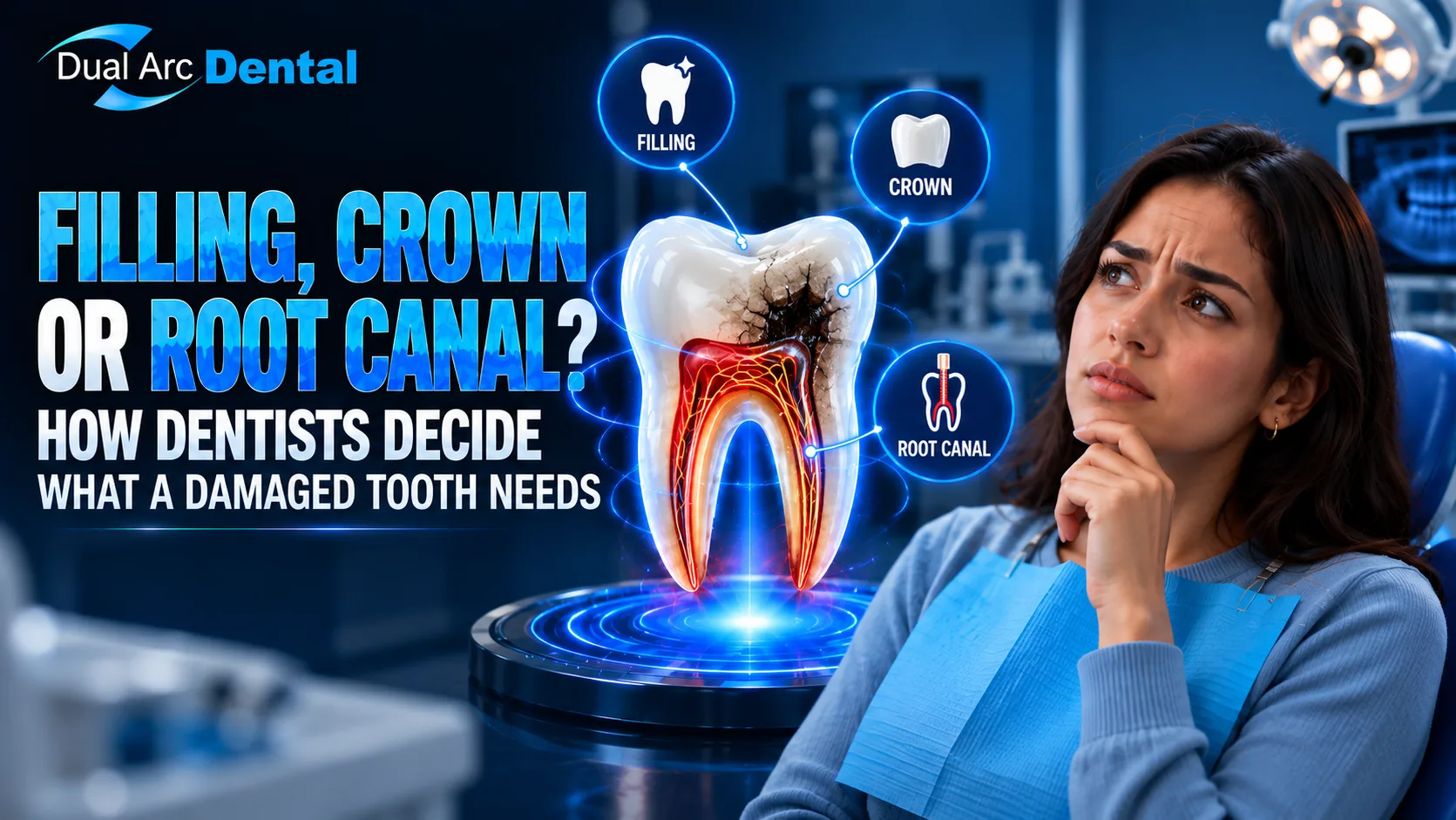
Filling, Crown or Root Canal? How Dentists Decide What a Damaged Tooth Needs
If you have a damaged tooth, this does not necessarily indicate that you must get a crown or root canal. Treatment will often depend on the extent of the tooth damage, whether the inner tooth structure is damaged, and whether there is any remaining healthy tooth structure. So, if you want to find a root canal near you, the first step isn't to presume that a specific treatment is required, but a thorough examination.
Dentists Aren’t Choosing Between Three Interchangeable Treatments
Sometimes fillings, crowns and root canals are discussed in the same context, as they can all be employed in cases where a tooth has been damaged. That doesn't mean they solve the same problem, though.
A dentist is not simply choosing the “stronger” treatment.
Instead, the decision is based on questions such as:
- How large is the damaged area?
- Is the tooth still structurally strong?
- Has decay reached deeper layers?
- Is the nerve or pulp involved?
- Is there a crack?
- Has the tooth previously been treated?
- Can the remaining tooth support a restoration?
A filling may be suitable for one tooth, while another tooth with a similar-looking problem may need considerably more support.
That is why the diagnosis comes before the treatment choice.
1. How Much Tooth Structure Is Damaged?
The initial consideration the dentist makes is the amount of healthy tooth remaining.
If only a small area is damaged, this could be a fairly simple restoration. When the damage is larger, the tooth may no longer have enough strength to function normally without additional protection.
Dentists may look at:
- The size and depth of decay
- Existing fillings
- Cracks or fractures
- Broken sections of the tooth
- The thickness of the remaining walls
- Whether the tooth can tolerate normal chewing pressure
This matters because a restoration needs to repair the problem without placing unnecessary stress on the remaining tooth.
A tooth with limited damage and a tooth with extensive structural loss should not necessarily be treated the same way.
2. Is the Damage Limited to the Outer Tooth?
A filling might be considered if the problem is relatively small and is contained within the outer structure of the tooth.
Typically, a filling will be used to repair or replace a small area of decay or minor damage.
The dentist will take out the damaged part and fill the area with suitable dental material.
A filling may be considered when:
- The affected area is relatively small
- There is enough healthy tooth remaining
- The damage has not significantly weakened the tooth
- The inner pulp is not affected
The important word here is may.
Cavities are not always apparent. To know the extent of the problem, the dentist may require an examination and X-ray of the mouth.
3. Does the Tooth Need More Structural Support?
A crown may be indicated if a tooth isn't structurally sound enough to be restored by a filling alone.
The crown is the part that is visible and is intended to reinstate the shape, function and strength of the tooth.
Crowns may be considered for teeth with:
- Large areas of decay
- Significant existing restorations
- Cracks or fractures
- Weak remaining walls
- Extensive structural damage
- Previous root canal treatment
Another example is if the filling is very large and the tooth is already very weak, it may not provide the tooth enough support.
In this instance, it's sometimes better to preserve what's left with a crown.
But if a crown is needed, it doesn't always require a root canal.
The condition of the inside of the tooth is a separate part of the decision.
4. Has the Inside of the Tooth Been Affected?
A root canal becomes relevant when the tissue inside the tooth, known as the pulp, is affected.
The pulp contains nerves and blood vessels. It can become inflamed or infected because of deep decay, significant cracks, trauma, or other forms of damage.
Dentists may consider root canal treatment when examination and testing suggest that the pulp cannot recover normally.
Possible findings may include:
- Deep decay extending toward the pulp
- Significant inflammation
- Infection
- Certain types of dental trauma
- Deep cracks affecting the inner tooth
- Changes root canal treatment around the root visible on dental imaging
The purpose is to treat the inside of the tooth, not just its outside.
In some cases, a crown may also be recommended afterward to provide structural support.
Put the Three Options Side by Side
Although all three treatments can involve damaged teeth, their purposes are different.
| Treatment | General Purpose | Situation It May Address |
|---|---|---|
| Filling | Repairs limited damage | Smaller affected area |
| Crown | Protects and restores a weakened tooth | Greater structural damage |
| Root canal | Addresses problems inside the tooth | Internal pulp involvement |
This comparison is useful, but it should not be treated as a self-diagnosis guide.
A damaged tooth may not fit perfectly into one category.
For example, a tooth may need a root canal and a crown. Another may need only a crown. A smaller cavity may need only a filling.
The final recommendation depends on what the dentist finds.
Why Symptoms Alone Can’t Tell You Which One You Need
Tooth symptoms provide useful clues, but they cannot reliably tell you which treatment is necessary.
Sensitivity, discomfort when chewing, or toothache can happen for several different reasons.
A painful tooth does not automatically require root canal treatment. Likewise, the absence of severe pain does not guarantee that the inside of the tooth is healthy.
Dentists may combine several types of information before recommending treatment, including:
- Your symptoms
- How long the symptoms have been present
- What triggers them
- Visual examination
- Dental X-rays
- Bite testing
- Sensitivity testing
- Examination for cracks
- Previous dental history
This is particularly important because two dental problems can feel almost identical to the patient while requiring very different treatment.
Trying to choose treatment based only on pain level can therefore be misleading.
Why Two People With Similar Toothaches May Get Different Recommendations
Imagine two people who both experience discomfort while chewing.
The first person may have a relatively small cavity affecting the outer portion of the tooth. If enough healthy structure remains, a filling may be considered.
The second person may have a deep crack that has significantly weakened the tooth. A crown may be more appropriate.
A third patient may describe nearly the same discomfort, but testing reveals that the pulp inside the tooth has been affected. That person may require root canal treatment.
So even when patients search for a root canal nearby because their symptoms seem serious, the actual treatment can only be determined after the tooth has been assessed.
Dentists are not treating the symptom alone.
They are trying to identify its cause.
The Goal Is to Treat What Is Actually Wrong
The purpose of dental treatment is not to choose the most extensive option. It is to address the problem appropriately while preserving healthy tooth structure whenever possible.
At Dual Arc Dental, we assess the condition of the tooth, how much healthy structure remains, the health of the pulp and any additional findings before discussing treatment options.
Our treatment will vary depending on our findings, including a filling, crown or another treatment.
If you are having ongoing tooth discomfort, sensitivity, discomfort chewing, or a broken tooth, an examination can help you find out what is going on, instead of speculating.
If a tooth is troubling you and you are searching for a root canal near you, we are able to evaluate the area and discuss the options that may be available based on the condition of the tooth.
Frequently Asked Questions
1. Can a filling prevent the need for a crown?
Sometimes. If damage is identified while it is still limited and enough healthy tooth remains, a filling may be sufficient. However, larger or structurally weakened teeth may require additional support.
2. Does needing a crown mean I also need a root canal?
No. A crown and a root canal serve different purposes. A crown strengthens and restores the outer tooth, while root canal treatment addresses problems involving the pulp inside the tooth.
3. Can a root canal be done without a crown?
It depends on the tooth, its location, and how much healthy structure remains. Some teeth may need a crown after root canal treatment, while others may be restored differently.
4. How does a dentist know whether the tooth nerve is damaged?
Dentists may use symptoms, dental imaging, sensitivity tests, bite tests, and clinical examination to evaluate the health of the pulp.
5. Can a large filling be used instead of a crown?
Sometimes, but not always. If too much tooth structure has been lost, a large filling may not provide enough support. The dentist will assess how much healthy tooth remains before recommending a restoration.
6. Why can’t I decide based on how much the tooth hurts?
Pain intensity does not always match the seriousness of the dental problem. Some significant problems cause relatively little discomfort, while minor issues can sometimes feel very sensitive. A clinical examination is needed to understand the cause.