

Can a Root Canal Fail? Warning Signs Every Patient Should Know
Nobody walks out of a dental office thinking their root canal will fail. The procedure worked. The pain stopped. Life moved on.
Then, six months later, something feels off.
That's the part most patients aren't prepared for, not because dentists hide it, but because nobody really expects to circle back to a tooth they thought was handled. The truth is, root canals do fail. Not often. But often enough that knowing what to watch for changes outcomes in a real, measurable way.
What Does "Failure" Actually Mean Here?
The procedure itself removes infected pulp, cleans the canals inside the tooth, and seals everything shut. Clean. Done. Except the seal isn't permanent in the way people imagine. It relies on the crown on top holding tight, the surrounding gum tissue staying healthy, and bacteria not finding a new way in.
Any one of those things breaks down, and the tooth is in trouble again.
There are a few specific reasons this happens more than others:
- A canal gets missed during treatment. Molars regularly have four or five of them. One that's overlooked stays infected.
- The crown gets placed late, or eventually cracks. The tooth underneath is exposed. Bacteria re-enter.
- The root tip develops a new abscess years after the original treatment, sometimes with no obvious trigger.
- Curved or narrow canals don't get fully cleaned. Residual tissue breaks down slowly over time.
None of these scenarios are about bad dentistry necessarily. Tooth anatomy is genuinely complicated. But knowing the failure modes makes the warning signs easier to spot.
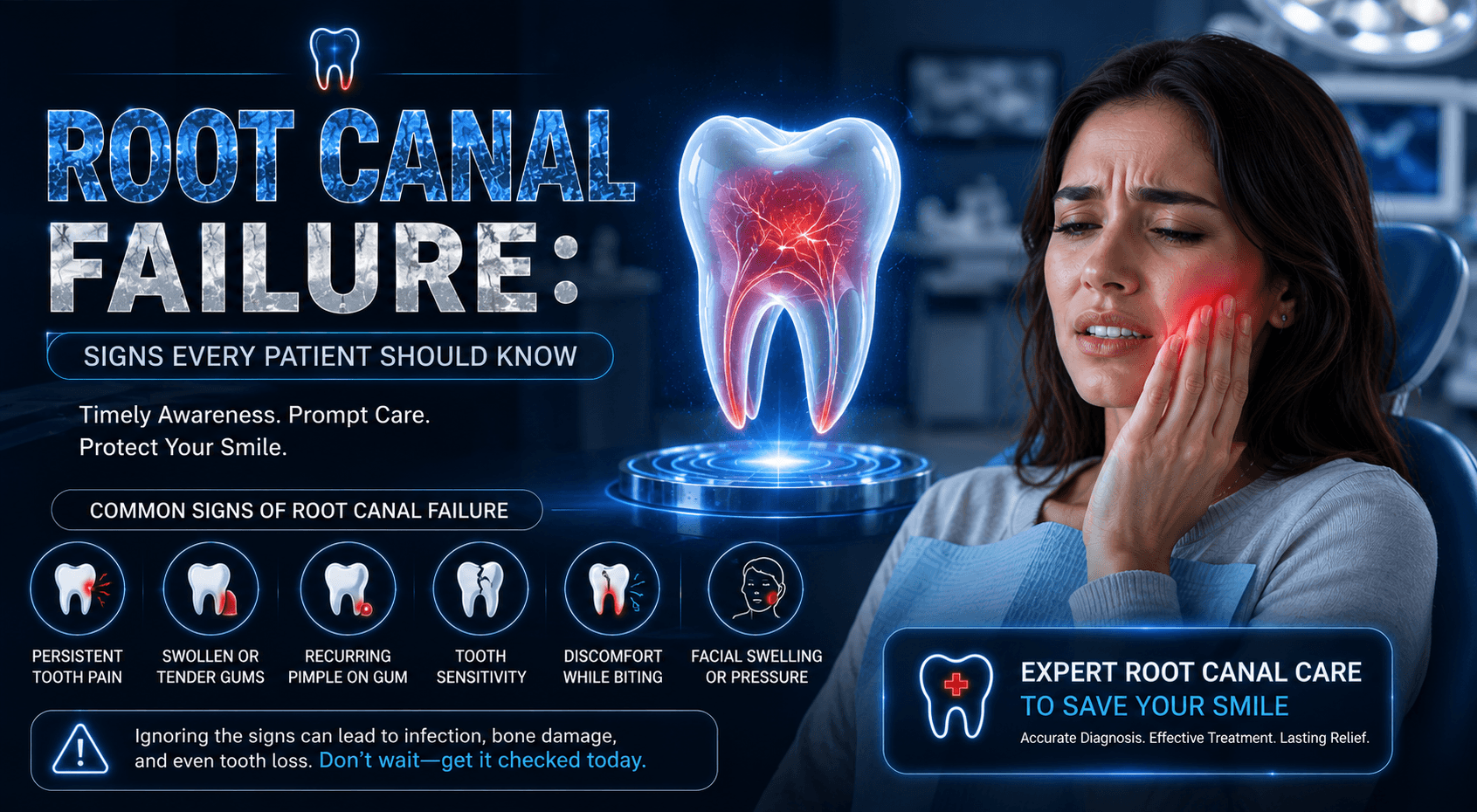
Signs The Tooth Is Telling You Something
Pain That Came Back After Going Quiet
This is the clearest one. Before a root canal, there's pain. After a successful one, that pain goes away within days to a couple weeks. If it comes back months or years later, unprovoked, persistent, not explained by something else, that's the tooth asking for attention. Don't ignore it.
A Bump On The Gum Near The Treated Tooth
Small. Pimple-like. Often painless. That bump is a fistula, and it forms when infection builds up pressure and the body tries to drain it somewhere. The fact that it's draining does not mean it's clearing. The infection source is still active underneath. The bump just reduces the pressure temporarily.
Swelling In The Face Or Jaw
Localized swelling near a previously treated tooth, especially if it developed quickly over a few hours, points to spreading infection. This one warrants same-day attention. Not a "call Monday" situation.
Sensitivity On Biting That Won't Quit
Some soreness after the procedure itself is expected. It usually fades. Tenderness that lingers past two weeks, or reappears months after the tooth felt fine, signals something is still wrong at the root level.
Tooth Darkening
A treated tooth can darken over time. Some degree of that is normal. What isn't normal is darkening that progresses steadily and comes with other symptoms. It can indicate internal breakdown of tissue that wasn't fully removed during the original procedure.
No Symptoms, And A Follow-Up X-Ray Catches It Anyway
This is the one people don't expect. Some root canal failures develop silently. No pain, no swelling, no obvious sign. The infection or bone loss at the root tip only shows up on imaging. Which is the exact reason routine dental X-rays at checkups aren't optional maintenance, they're the only way to catch what the tooth isn't announcing on its own.
What Early Detection Actually Changes?
Retreatment works. When failure is caught before significant bone loss has set in, a dentist goes back into the canals, removes the old filling material, cleans more thoroughly, and reseals. Most teeth treated this way survive long-term.
If the damage is further along, an apicoectomy, a minor surgical procedure that removes the root tip and infected tissue directly, can save a tooth that retreatment alone can't reach.
Extraction is a last resort. But reaching it requires waiting long enough that options run out. Catching things early keeps more options on the table.
The Part Most Patients Get Wrong
They assume silence means success. A tooth that stopped hurting after a root canal gets filed under "handled" and forgotten. Follow-up feels unnecessary.
That assumption is where problems grow. The tooth needs periodic check-ins. The crown needs to stay intact. Symptoms that seem minor- a little tenderness here, a strange sensation there- deserve a conversation with a dentist before they escalate into something that forecloses simpler solutions.
At Dual Arc Dental in Schertz, TX, Dr Viral Patel and Dr Vaidehi Mehta provide endodontic care and long-term follow-up so treated teeth stay healthy. If something feels off, call (210) 375-5256, not next month.
FAQs
1. How common is it for a root canal to fail?
Root canals have a high success rate, but failures can occur due to factors such as complex root anatomy, new decay, a damaged crown, or reinfection. Regular dental checkups help identify potential problems before they become more serious.
2. How long after a root canal can a failure happen?
A root canal can fail within months or even many years after treatment. That's why it's important to continue routine dental visits, even if the treated tooth has been symptom-free for a long time.
3. Can a failed root canal be treated without removing the tooth?
In many cases, yes. Depending on the cause, your dentist may recommend root canal retreatment or an apicoectomy to eliminate the infection and preserve the natural tooth. Extraction is typically considered only when the tooth cannot be saved.
4. What should I do if I notice pain or swelling around a tooth that previously had a root canal?
Contact your dentist as soon as possible. Recurring pain, swelling, or a pimple-like bump on the gums may indicate reinfection or another complication that requires prompt evaluation and treatment.
5. How can I reduce the risk of root canal failure?
Maintain good oral hygiene, attend regular dental checkups, protect the treated tooth with a permanent restoration if recommended, and seek dental care promptly if you notice any changes such as pain, swelling, or difficulty biting.