

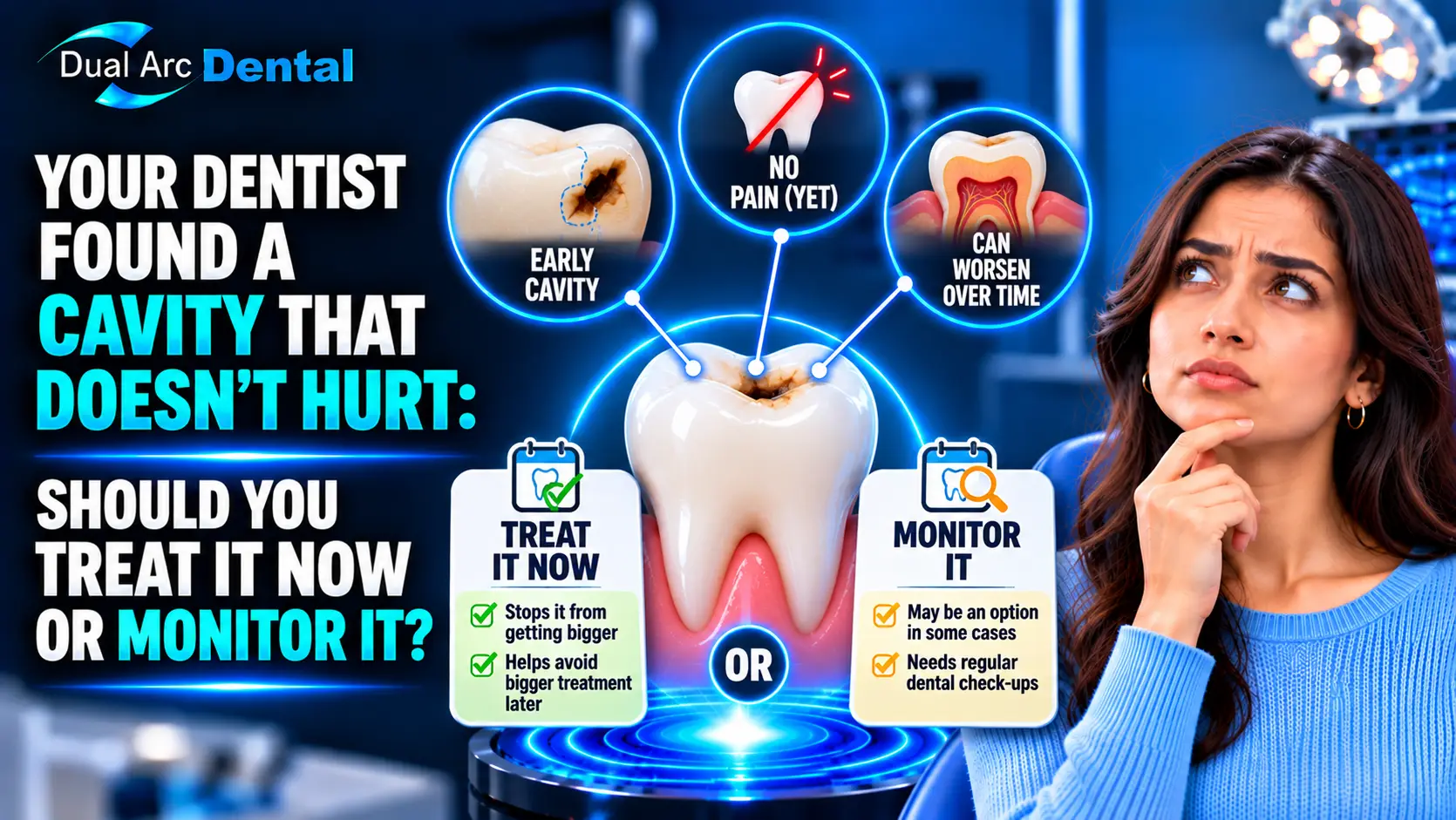
Your Dentist Found a Cavity That Doesn't Hurt: Should You Treat It Now or Monitor It?
Finding out you have a cavity during a routine checkup can be surprising, particularly when the tooth feels perfectly fine.
You haven't noticed sensitivity. Chewing isn't uncomfortable. There isn't even a visible hole, as far as you can tell. Yet your dentist points to an area on the X-ray and recommends keeping an eye on it or scheduling a filling.
Naturally, you want to know whether treatment is really necessary.
The answer depends on how far the decay has progressed. Some early cavities can be managed without drilling, while others are better treated before more tooth structure is lost.
Pain isn't the deciding factor. The condition of the tooth is.
Why Can a Tooth Have a Cavity Without Hurting?
Tooth decay doesn't usually begin with a toothache.
Bacteria in dental plaque produce acids that gradually weaken enamel. During the early stages, this process may leave a chalky white area or a change that's barely noticeable.
Enamel doesn't contain nerves, so damage limited to this outer layer may cause no discomfort.
Even when decay extends into the dentin beneath it, some people don't experience obvious symptoms.
Pain is more likely when deeper tissues become irritated or infected, although symptoms vary from person to person.
That's why a dentist can find decay long before you notice anything wrong.
Waiting for pain before treating a cavity isn't always sensible. But finding early decay doesn't automatically mean you need a filling, either.
An Early Area of Decay Isn't Always a Hole
There's an important difference between enamel that's beginning to lose minerals and a tooth that has developed an actual cavity.
Dentists call early decay without a broken tooth surface a noncavitated lesion.
At this stage, the enamel may still be intact. With appropriate care, the weakened area can sometimes regain minerals or stop progressing.
A cavitated lesion, on the other hand, involves a physical breakdown of tooth structure.
Once part of the tooth has been lost, brushing and fluoride alone generally won't rebuild its original shape.
However, some cavitated lesions may still be managed using non-drilling treatments in selected circumstances. Your dentist considers the location, depth, and activity of the decay before deciding whether a restoration is needed.
This distinction is worth asking about at your next appointment.
When Might Your Dentist Recommend Monitoring?
Monitoring can be appropriate when the enamel surface is intact, the decay appears limited, and there's a reasonable chance of stopping its progression.
Your dentist may recommend fluoride treatment, changes to your home-care routine, or protective sealants for certain areas of the tooth.
A small early lesion between two teeth may require a different approach from decay developing inside the deep grooves of a molar.
The decision also depends on your cavity history.
Someone who rarely develops decay and maintains good oral hygiene may have a different monitoring plan from someone who has needed several fillings recently.
At Dual Arc Dental's general dentistry service, preventive examinations, fluoride treatments, and dental sealants are among the available services.
The purpose of monitoring isn't simply to postpone treatment. It's to manage early decay while preserving healthy tooth structure whenever possible.
What Does Monitoring a Cavity Actually Involve?
If your dentist recommends watching an early lesion, ask what you're expected to do between visits.
Brushing twice daily with fluoride toothpaste is important. Cleaning between teeth also helps, especially when decay is developing near the contact points.
Reducing frequent sugary snacks and drinks can make a difference.
It's not only the amount of sugar that matters. Repeated exposure throughout the day gives plaque bacteria more opportunities to produce acid.
Your dentist may recommend professional fluoride applications or a prescription-strength toothpaste, depending on your cavity risk.
At follow-up appointments, they may compare clinical findings and X-rays when appropriate to see whether the area has remained stable.
Monitoring only works when someone checks whether the decay is changing.
If the lesion grows or the tooth surface breaks down, the treatment recommendation may change.
When Is Getting a Filling the Better Choice?
Suppose decay has already created a hole that traps food and is difficult to clean.
Even if it doesn't hurt, the damaged area may continue collecting plaque. In that situation, a filling could be the more predictable option.
Your dentist removes the damaged tissue as appropriate and restores the tooth's shape using a suitable material.
Tooth-colored composite fillings are commonly used for many small and moderate cavities.
The size and position of the cavity matter, as does the amount of healthy tooth remaining.
A large area of damage may need a different restoration, such as a crown, to protect the tooth during chewing.
Dual Arc Dental offers restorative dentistry, including tooth-colored fillings and dental crowns.
The recommended treatment should be based on what the tooth needs, not simply whether it's causing discomfort.
Can You Wait Six Months Before Treating a Painless Cavity?
Sometimes a dentist will recommend reassessing an early lesion at a future visit. That doesn't mean six months is appropriate for every cavity.
Active decay may progress during that time.
The dentist considers how quickly the lesion appears to be developing, its location, your cavity risk, and how reliably it can be monitored.
If a filling has been recommended, ask what the risk would be if you delayed treatment.
You might also ask whether a non-invasive treatment is appropriate or whether the area has already lost enough structure to require repair.
Those questions can help you understand the recommendation without assuming that every painless cavity should be left alone.
What if the Dentist Finds Decay Under an Old Filling?
This situation can be harder to judge because part of the tooth is covered by an existing restoration.
Decay may develop near the edge of a filling if that area becomes difficult to clean or the restoration begins to deteriorate.
Your dentist may examine the margins, check for visible damage, and use X-rays when appropriate.
Not every discolored line around a filling means there's active decay.
Similarly, not every old filling needs replacing simply because it has been there for years.
A replacement may be recommended when there is evidence of active decay, a fracture, or another defect that affects the tooth.
Questions Worth Asking Before Agreeing to Treatment
You don't need to challenge your dentist to understand why a particular procedure is being recommended.
Ask where the decay is located and whether the enamel surface is still intact.
Find out whether the area appears active or stable, and whether previous X-rays show any change.
If monitoring is an option, ask what treatments might help stop progression and when the tooth should be checked again.
If a filling is recommended, ask what could happen if you waited.
A dentist should be able to explain the findings in everyday language so you understand the benefits and limitations of each approach.
A Painless Cavity Still Deserves a Clear Treatment Plan
Finding a cavity doesn't always mean you need to schedule a filling immediately. But having no pain isn't enough reason to ignore it.
The useful question is whether the decay can be controlled while the tooth remains intact or whether restoring it now would prevent further damage.
At Dual Arc Dental, patients in Schertz, Cibolo, Selma, Universal City, and nearby communities can schedule dental examinations and discuss their treatment options.
If you've been told you have a cavity but aren't sure whether to treat it or monitor it, contact the practice to arrange an appointment.
Dual Arc Dental
1248 FM 78, Suite 105, Schertz, TX 78154
Phone: (210) 375-5256
Before making a decision, ask to see what the dentist found. Understanding the condition of the tooth is a better starting point than waiting for it to hurt.
Frequently Asked Questions
1. Does every cavity need a filling?
No. Early decay without a physical hole can sometimes be managed using fluoride, sealants, or other non-invasive treatments. More advanced cavities may require restoration.
2. Can a cavity heal on its own if there's no pain?
Early enamel damage can sometimes remineralize with appropriate fluoride exposure and changes to oral care. A physical hole in the tooth generally won't rebuild itself naturally.
3. How does a dentist know whether a cavity is getting worse?
Dentists compare clinical examinations, changes in tooth structure, and dental X-rays when appropriate. They also consider whether the lesion appears active and your overall cavity risk.
4. Is it safe to leave a small cavity untreated?
Monitoring may be appropriate for certain early lesions, but it should be a planned decision. A small cavity can progress without causing pain, so follow-up matters.
5. Can fluoride prevent an early cavity from becoming bigger?
Fluoride can help strengthen weakened enamel and slow or stop some early decay. Its effectiveness depends on the stage of the lesion and other factors such as diet and oral hygiene.
6. Where can I get a second opinion about a painless cavity in Schertz?
If you're looking for a dentist in schertz, Dual Arc Dental offers dental examinations and treatment planning. You can ask the dentist to review the findings and explain whether monitoring or restoration is appropriate.